

Kevin Simler is a writer and software person living in San Francisco.
Previously in this series: Mr. Jaynes’ Wild Ride (1), Accepting Deviant Minds (2), Neurons Gone Wild (3)
We’ve laid a lot of groundwork over the past two months for me to be able to say this with a straight face:
Julian Jaynes believed that ancient people experienced their gods as auditory hallucinations.
OK, maybe I cringed a little.
For those of you just joining us, this is part 4, the final stop on our idiosyncratic tour of Julian Jaynes’s The Origin of Consciousness. For the past three essays we’ve been tiptoeing around the ‘gods’ as though they were elephants in the room, but today we will confront them and engage with them directly.
If you haven’t read Jaynes — well, you should. It’s some of the most mind-expanding material you’ll ever encounter. (”Cognitive archaeology”: how’s that for a field of study?) As I mentioned earlier, the consensus on Jaynes is that his book is worth reading even if his thesis is completely wrong. That alone should pique your curiosity.
But if you haven’t read Jaynes, you’ll be tempted to place him on the lunatic fringe, in company with conspiracy theorists, Ancient Alien-types, and Philip K. Dick (the later years). But please don’t do this. It would be a mistake. Even if Jaynes is wrong, the man is as rational and grounded — as ‘properly-hinged’ — as anyone who asks these kinds of questions can be.
I’ve spent a lot of effort, these past two months, preparing us not to reject the idea of hallucinated gods out of hand. But now I ask that you keep just one thing in mind as you continue to read about Jaynes — namely, this objective fact about our species:
The human brain is capable of hallucinating voices.
Yes, hallucinated voices are weird — but they really happen. And sometimes we can even be quite cavalier about them. Every night, for example, we spend an hour or so immersed in a rich hallucinated fantasyland — only to dismiss it, when we wake up, as “just a dream.”
Wait a minute. “Just” a dream? If a dream wasn’t perfectly normal, it would be the weirdest thing that ever happened to you.
So this should give us pause.
In particular, we can assume that whatever our brains are capable of doing while we’re asleep, they’re capable (in principle) of doing while we’re awake. This includes hallucinating voices. Hallucinations can happen to anyone (and they often do), but they’re most common in schizophrenic patients, in something like 1% of the population.
Now schizophrenia may be a disease — a dys-functional state — but it’s not like a virus invades the brain and tickles our neurons to create marionette-like performances. The voices come from inside the brain itself. And so it shouldn’t surprise us when the voices exhibit real intelligence (by using language, understanding complex situations, or making unexpected inferences). Brains are capable of intelligence, after all — and schizophrenic voices are realized in gray matter, just the same as ‘you’ and ‘me.’
If you think about schizophrenia long enough, you’re forced to the conclusion (however uncomfortable) that each voice is an independent network of neurons that lives inside the brain. But these voices aren’t just passively housed in the brain — they’re alive in there, in a very real sense.
If we have trouble accepting this, it’s because we’re chauvinists. We fancy not only that our ‘selves’ are in full control, but also that our selves are the only locus of control and intelligence in our brains. (We’re especially fond of this idea here in the modern West.) In the ‘government within’, our selves claim absolute authority. Occasionally we’ll grant some kind of intelligence to our unconscious minds, but we imagine that it’s all somehow done in service to ‘us’ — that it’s really somehow our intelligence. We reject, with extreme prejudice, the notion that the brain could harbor any independent intelligence, with an agenda other than our own. And if such a ‘rogue’ intelligence could somehow command verbal skills and talk to us — why, that would be truly subversive.
And yet this is exactly what Julian Jaynes is proposing.
The “bicameral” mind
Jaynes’s hypothesis concerns humans living in large agrarian empires and city-states, starting in about 10,000 BC and extending through about 1000 BC. He focuses on societies around the Mediterranean — in Egypt, the Levant, Mesopotamia, and Greece — and mostly punts on whether his theory applies to early Indian, Chinese, or American societies.
The idea is that in these ancient Mediterranean civilizations, the typical human had one or more ‘gods’ — spirits, agents, separate intelligences — living alongside the conventional ‘self’ in the brain. In other words, the dominant pattern was to maintain two separate, verbally-intelligent control centers in the same brain — one for the ‘gods’ and one for the ‘humans’/’mortals’/’selves’.
(I’ll stop using the scare-quotes now.)
Jaynes refers to this arrangement as bicameral, which means two-chambered. That’s because he postulates that the gods and conventional selves were headquartered in the two chambers of the brain — the right and left hemispheres (respectively). I think this is plausible enough, but Jaynes admits that it’s speculative, and it’s not strictly necessary for the rest of his theory. What matters is only that the human brain is (empirically!) capable of something like this arrangement.
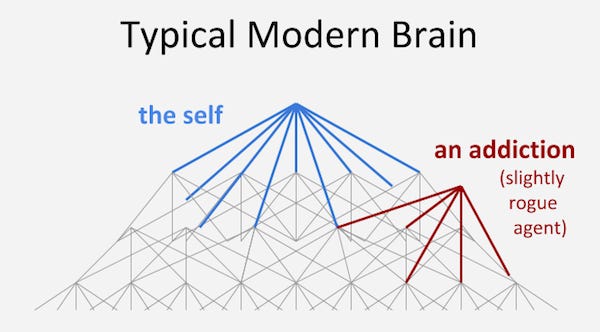
This is how I picture it working. Here’s what we think of as a normal human brain:
And here’s a bicameral brain:
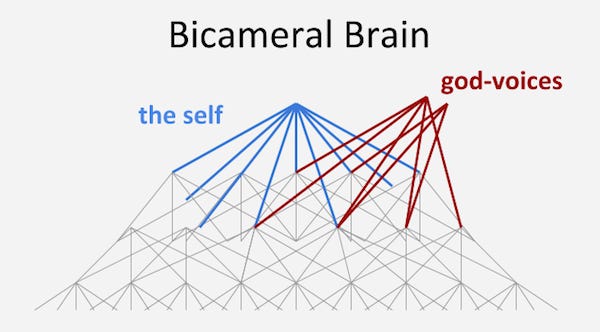
In each case, the red (rogue) network has some independence from the blue (self) network. The difference is that, in a typical modern brain, the rogue network exists at a much lower level, whereas the gods in a bicameral brain exist at (more or less) the same level as the self and, crucially, can call upon the language and reasoning faculties directly.
So, now, imagine you were a person — a human self — living in Sumer in 2000 BC. What would your inner life be like? How would you have experienced the world?
In many ways you would have been just like a typical modern human. The crucial difference is that you would have experienced occasional, or perhaps frequent, auditory hallucinations: the voices of your god or gods. You would have heard them clearly and distinctly, as though they were actual voices coming from the outside world (much like today’s schizophrenics). The voices would speak to you in the form of commands, admonishment, and advice. Sometimes they would have been accompanied by visual hallucinations as well, whether as an anthropomorphic figure (very rare) or simply as a visual glitch — like a swirling mist or burning bush, similar to what people experience today using psychedelics.
According to Jaynes, the gods would primarily speak up during stressful, novel situations, i.e., whenever an interesting new decision needed to be made. In 2000 BC, you wouldn’t need a god to tell you when to scratch your leg, but if you encountered a menacing stranger on your walk home, one of your gods — sensing danger — may well have commanded you to “Run!” Once safe, you surely would have thanked your god for his or her benevolent wisdom.
In other words, the gods took on some of the functions we think of as the “will” or volition. (But not the conscience; that would only later become a function of a very different kind of god.) Here’s Jaynes:
The gods were in no sense ‘figments of the imagination’ of anyone. They were man’s volition. They occupied his nervous system... and from stores of admonitory and preceptive experience, transmuted this experience into articulated speech which then ‘told’ the man what to do.
Think of it this way. Today we have a lot of mental phenomena we can’t really account for, like “intuitions” or “gut feelings.” We put a lot of stock in these feelings, even though they’re often hard to ‘read.’ After a while, we learn to trust the feelings (in the moment), and worry about deciphering them afterward. So for example you might walk into a meeting with some potential new business partners and get an instant “bad feeling” about it. Now imagine that “bad feeling” in the form of a voice telling you, “Be careful! Don’t agree to anything!”
That’s what the bicameral mind probably felt like.
Training the gods
Of course children don’t come out of the womb with their divine voices pre-wired. Like any brain habit, the gods of the ancient world needed to be trained.
According to Jaynes, a child in a bicameral society learned to hear his voices by internalizing the advice, admonishment, and direct orders from his parents and other authority figures. As he grew up, he would internalize other voices, such as those of his bosses, priests, or political leaders. Along the way he would be actively coached in this process, and aided by external triggers like special awe-inducing spaces (temples, shrines), special hallucinogenic images (statues, idols), and special substances (incense, drugs).
Whether all these influences coalesced into a single voice (representing a single god), or retained separate identities (representing multiple gods), would depend on a lot of different factors. Perhaps it was largely a matter of chance — although some cultures, even polytheistic ones, probably encouraged a single personal god, while others were supportive of someone hearing multiple gods.
Cultures would have similarly differed in how children learned to identify their gods. Since I can’t hear your hallucinated voices and you can’t hear mine, how do we know whether we’re listening to the same gods? Answer: we don’t.
What I mean is that there’s no objective sense in which one of your voices could be the “same” as one of my voices. The process of naming/identifying one’s voices is strictly a symbolic, interpretive act — and as such it would have been fraught with social and political implications. There were personal gods, household gods, state and local gods, each a meaningful token of a different kind of loyalty. No doubt identification was influenced by all sorts of factors in the child’s life: his parents, priests, and peer group; norms about whether it’s OK to ‘invent’ new gods; where he spent his time; where he heard his voices. If a child hallucinated one of his voices with particular strength at the temple of Osiris, while bathing in the imagery, mythology, and personality of Osiris — well, it only makes sense for that voice to ‘be’ Osiris.
In this way, god-identification might not have been so different from the identity crises experienced by adolescents today. A high-schooler vacillating between an artistic and an intellectual identity is in some sense being pulled toward two different gods.
The fact that it’s not always easy to identify one’s gods resolves a puzzle that had long baffled me: Why Yahweh keeps reintroducing himself (to Isaac, Jacob, Moses, Isaiah, and others) as “the god of your fathers.” For example, as Moses is investigating the burning bush in Exodus,
God called to him from within the bush, “Moses! Moses!”
And Moses said, “Here I am.”
“Do not come any closer,” God said. “Take off your sandals, for the place where you are standing is holy ground.” Then he said, “I am the God of your father, the God of Abraham, the God of Isaac and the God of Jacob.” At this, Moses hid his face, because he was afraid to look at God.
I always used to think: There’s only one God, right? So if Moses heard a voice, wouldn’t he know whose it was? And why the reference to Moses’s ancestors? But now I understand. Exodus was written for an audience familiar with the problem of hearing voices (plural) and trying to identify them — and Yahweh’s remarks make perfect sense in this context. He’s authenticating himself, by establishing continuity with the voices heard by the previous patriarchs. Of course there’s no objective truth about whether the voice heard by Moses was the same as the voice heard by Jacob or Abraham. But as long as everyone accepts the claim — Moses, his fellow tribesmen, the audience reading the Book of Exodus — then it has de facto social truth, which is the only truth this kind of claim ever really needs.
Psychosocial phenomena
As we’ve seen, bicameral gods had both neurological and cultural representations. These representations were tied together by an interpretive act — identification — which was influenced by personal, social, and political factors.
In this way, the ancient gods were psychosocial phenomena.
As soon as you’ve identified one of your voices as Osiris, for example, then whatever the priests say about Osiris becomes personally relevant to you, and can even exert real influence on you. (Of course it doesn’t hurt that you’re likely to follow the priests anyway, because they’re powerful and well-connected.) Jaynes postulates that this mode of social control, facilitated by the bicameral mind, is what allowed large, dense, hierarchical city-states to form in the first place.
Incidentally this is also what happens with words (another psycho-social phenomenon), only the effect is much weaker. A word like “art,” say, exists in some neural representation in your brain, but it also exists externally as a cultural concept. Whatever people are saying about “art,” then, can affect you in a very direct way. This is why we’re always fighting over what “art” means, what its boundaries are, etc. If our whole culture comes to agree that software is a form of “art,” for example, then you’ll automatically start to conceptualize software differently, and perhaps change your relationship to it.
So too with the gods — except that a ‘god’ or ‘spirit’ in your brain has a lot more power than any word, because it’s alive in there. It’s a fully animated concept, with agency of its own. As it happens, words aren’t completely dead and lifeless; they’re just like little fledgling gods. They can pop to mind unbidden, shift in meaning, and become more or less salient. But they have nowhere near as much intelligence or independent agency as a hallucinated voice.
Banality of the gods
When I first heard this idea — that the ancients hallucinated their gods — my reaction was disbelief. “No way,” I thought. “If this is true, why didn’t the ancients document it?”
The answer (I was shocked to realize) is that they did. Pretty often in fact. I just wasn’t paying attention.
From Gilgamesh to the Iliad, from the Old Testament to the Code of Hammurabi, from private letters to the most public steles — all portray an intimate, visceral, real relationship between gods and humans. This is so utterly different from the kind of relationship we see today (between the Abrahamic God and His followers) that I had always just assumed that the ancients were being poetic, manipulative, delusional, or some combination thereof.
But these texts are so consistent on the reality of the gods, and so casual about them (in ways that shock the modern sensibility), that it points to a completely different mentality, and calls out for a more generous interpretation.
Today our God is abstract, distant, formless, and silent — in other words, merely conceptual. This is what happens when a god becomes neurologically weak. And paradoxically, it’s exactly what allows him to be portrayed as omnipotent, omniscient, etc. He becomes, in effect, a blank slate on which to project all of our most grandiose ambitions.
But when the gods are real, there’s far less wiggle room in how they’re portrayed. And all around the ancient Mediterranean, the gods were very real. We see this in all the descriptions of them. These were concrete, vibrant, physically present gods — chatty and full of personality. They could be jealous, petty, lustful, vengeful, playful. If they sometimes acted like children (ok, often), it’s because they were ‘just’ brain networks, and as such needed time and feedback in order to mature and become civilized. If they seemed all too human, it’s because they’re ontologically the same type of creature as a human.
Just as real were the relationships between gods and men in the ancient world. The gods spent their time hanging out with mortals, walking side-by-side with us, engaging in back-and-forth dialogue. They would appear frequently, in dreams, “visions,” or other hypnotic scenes. Sometimes a god would speak through a person (i.e., a prophet), quite literally — probably by way of possession.
Meanwhile, other types of brain-spirits were similarly prevalent. “Familiars” were a common problem. The Old Testament has all sorts of injunctions against consorting with familiar spirits and/or with people who have them — yet no one denies the reality of the spirits. Poets invoke their Muses at the beginning of each work, and then again in the middle, as they get stuck and have to re-conjure the voice.
Spirits show up in personal documents as well. “Letters,” says Jaynes, “were written to the dead as if they still lived.” He goes on (emphasis mine):
A man writes his dead mother asking her to arbitrate between himself and his dead brother. How is this possible unless the living brother had been hearing his dead brother in hallucination? Or a dead man is begged to awaken his ancestors to help his widow and child. These letters are private documents dealing with everyday matters, and are free of official doctrine or make-believe.
All of these intimate, detailed relationships with gods and spirits and no one was skeptical of it.
In all these texts, interactions with the gods are portrayed as not just believable, but utterly unremarkable, perfectly mundane. It’s only by the 5th century BC, when hallucinations were no longer pandemic, that we start to find clear skepticism. “Concerning the gods,” Protagoras says, “I have no means of knowing whether they exist or not or of what sort they may be.”
But earlier, if Jaynes is right, the existence of the gods simply wasn’t up for debate. That they existed was a fact anyone could observe, just by listening.
Breakdown of the bicameral mind
Somehow, between about 1250 and 500 BC people stopped experiencing their gods as hallucinations. Jaynes calls this period the “breakdown of the bicameral mind.”
The texts and other records from this period are quite poignant. There is much grief over the loss of the gods. Here’s Jaynes, for example, describing a stone altar:
About 1230 B.C., Tukulti..., tyrant of Assyria, had a stone altar made that is dramatically different from anything that preceded it in the history of the world. In the carving on its face, Tukulti is shown twice, first as he approaches the throne of his god, and then as he kneels before it.... As our eyes descend from the standing king to the kneeling king just in front of him, it is as emphatic as a moving picture, in itself a quite remarkable artistic discovery. But far more remarkable is the fact that the throne before which this first of the cruel Assyrian conquerors grovels is empty.
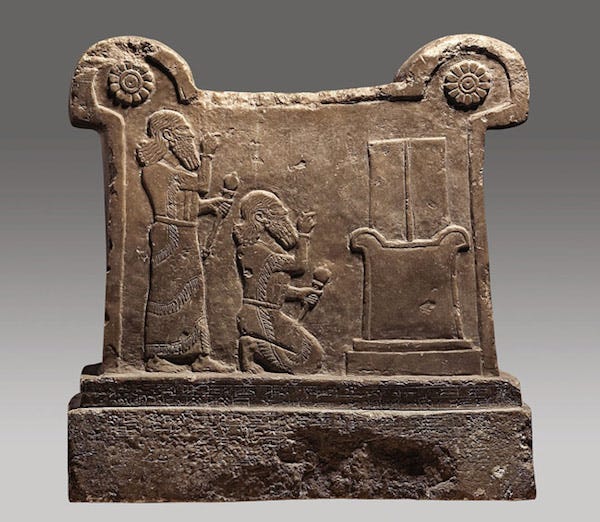
Jaynes continues:
No king before in history is ever shown kneeling. No scene before in history ever indicates an absent god. The bicameral mind had broken down.
Elsewhere man’s desolation is rendered in poetry. From the Ludlul bel nemeqi:
My god has forsaken me and disappeared, / My goddess has failed me and keeps at a distance. / The good angel who walked beside me has departed.
or from the Babylonian Theodicy:
May the gods who have thrown me off give help, / May the goddess who has abandoned me show mercy.
or in Psalm 22:
My God, my God, why have you forsaken me?... / My God, I cry out by day, but you do not answer
All of these were written in the span of a couple hundred years.
Now imagine what it must have felt like to have the gods abandon you. Your god-voices were the source of some of your most important intuition and volition. It would be like suddenly having no basis for making decisions.
Today we know perfectly well how to make decisions: we think about our goals, list out our options, listen to reasons, evaluate and weigh all the evidence for each option (including some of our inarticulable feelings), and ultimately choose whichever one is best.
If all of that sounds incredibly obvious to you, sitting here in the 21st century — well that’s kind of the point. This decision-making model is like the air we breathe; it’s been the substrate of Western civilization for some 2500 years now, since the Axial Greeks. All of us are raised, from infancy, by a culture that uses this model to make decisions — or at least to talk about how decisions are made. (Damasio describes how we actually make decisions.) My 3-year-old nephew, for example, is exposed to this decision-making model many times a day, as his parents discuss options, explain how each option fits into a goal, and ply him with reasons. “Because I said so,” is the frustrating exception that proves the general rule.
But the idea of a “conscious, reasoning will” was a set of protocols and a way of thinking that had to be invented (and catch on) sometime between 1250 and 500 BC, once the gods stopped acting as people’s volitions. And in the interim, people probably used a number of techniques to compensate for their missing gods.
These techniques included the crude decision-making algorithms known as divination methods, wherein people attempt to divine a decision — the “will of the gods” — by means of something other than direct auditory hallucination. Divination methods include: sortilege or casting lots, omens and omen texts, divination by dreams (oneiromancy), augury, and spontaneous divination.
Jaynes invites us to think of these as primitive psychological ‘technologies’ for the purpose of making decisions in the face of crippling uncertainty. As such, they started to appear (according to Jaynes) only at the end of the second and beginning of the first millennium BC, when the gods deserted us.
Conclusion
So here’s where I should probably tell you that Jaynes’s theory, however brilliant and beautiful, is merely a cute story — an interesting but fatally flawed hypothesis.
I should tell you that — but I’m not going to.
Instead, I’m going to say that I believe Jaynes is more right than wrong. And insofar as I hesitate, it’s not because I can’t swallow the hallucinations — or because I know of a theory that better explains the facts. It’s simply because he’s making an extraordinary claim for which I haven’t seen extraordinary evidence. Good evidence, yes, but not extraordinary.
I do have my share of criticisms and serious reservations about Jaynes’s theory. I’ve done a fair amount of cherry-picking here, in this series of essays, in order to portray his theory in the most favorable light. He’s pretty adamant, for example, that ancient people weren’t conscious — a claim I find very hard to swallow.
But on net, I think he’s showing us something true. As Dennett says, “If Jaynes is completely wrong in the details, that is a darn shame, but something like what he proposes has to be right.”
In other words, if Jaynes is crazy, it’s the kind of crazy we could all stand to be.
However, in his book I Am a Strange Loop, Douglas Hofstadter describes in a pretty moving way the conversations he has with his dead wife. Humans have "mirror neurons," which allow us to copy individual behaviors of other humans. This is useful in the short term, because it enables us to learn through observation as well as through trial and error.
Hofstadter takes this concept further, to suggest that over the years he knew his wife, his memories of her coalesced into a mental model, a copy of her personality that he carries around in his own brain. At first it was fuzzy and not very useful for predicting her behavior, but as he learned more about her, the model grew in detail and sophistication. After her death, he continued to interact intensively with that internal model, asking its advice on raising their children and generally treating it as though it were a person, keeping those memories alive and vivid.
http://www.intergalacticmedicineshow.com/cgi-bin/mag.cgi?do=columns&vol=randall_hayes&article=001
Jaynes's book was his PhD thesis: he had a really cool idea and did all he could to argue that it was correct. Castaneda's The Teachings of Don Juan: A Yaqui Way of Knowledge was his PhD paper at UCLA. He probably faked most or all of it. When called on by a PhD supervisor to produce his field notes he gave a sort of "the dog ate 'em" excuse and was awarded the PhD anyway. Are his ideas still valuable? A lot of people think so.
We come up with really cool ideas and then work to show they're more plausible than you'd think.
This is the function of a lot of intellectual work: as Isaiah Berlin said, intellectuals are people who want ideas to be as interesting as possible. Peter Berger said that intellectuals invent ideas which, if they're not strictly "true" they ought to be true.
More generally the best intellectuals do work that creates new space for intellectuals to work in. (See Randall Collins's The Sociology of Philosophies.)
In Jayne's work he didn't know about the Sperry-Gazzaniga split brain experiments? Is that right? Sperry-Gazzaniga severed the corpus callosums of patients whose epileptic fits were so extreme their lives were becoming unmanageable. The corpus callosum is a thick band of nerve fibers that separate the right and left hemispheres of the brain. Their operations cured the patients of intractable epilepsy, but they quickly found there now seemed to be "two" people in these patients, depending on which hemisphere was addressed, and this data applies to all of us, and Sperry got the Nobel in 1981, not only for this work, but a larger body of neuroscientific breakthroughs.
All of this work has fed the pop psychology of right-brained people and left-brained people, etc.
The best work most recently, to my mind, is Iain McGilchrist's magisterial The Master and His Emissary.
Jaynes is wrong. Jaynes is immortal, though. Wonderful piece, Kevin Simler! Thank you!