

Eli Stark-Elster is the author of Unpublishable Papers and a PhD student in Anthropology at UC Davis. He studies the subjective effects, neural dynamics, and cross-cultural uses of psychedelics. He conducts fieldwork in Southern Africa, where he recently documented the first clear evidence of indigenous psilocybin use outside the Americas.
When people take psychedelics, they sometimes see and interact with strange entities. Southern African shamans prescribe a plant called seipone to their patients: the patients drink a brew, stare into a mirror, and watch their ancestral spirits emerge from it in high definition. Eating certain bolete mushrooms without cooking them will make you see hundreds or thousands of tiny people. Famously, DMT catapults you into an alien world inhabited by “machine elves” and other alien beings.
One obvious explanation is that your brain does weird things on drugs. Maybe psychedelics make your senses go crazy, and you interpret the garbled outputs as “agents” because that’s the way our minds make sense of chaotic data. We see aliens in our heads for the same reasons we see faces in the clouds — we’re social creatures, so we interpret anything hard to parse as a fellow social creature.
The other obvious explanation is that the entities are real.1
This is a more controversial view. For most of my life, I haven’t taken it seriously. But that changed after I read a recent article by Michael Levin, titled “Ingressing Minds: Causal, Non-Physical Patterns In-Form Natural, Synthetic, and Hybrid Embodiments.”
To understand why my view has changed, and the theory underlying the change, you’ll need to understand his article — I’ll spend the next section of this post explaining it. Even if you don’t care about psychedelics and consciousness, I still think it’s worth understanding. I believe that the theory Levin describes is nothing less than a Copernican revolution for biology.
Shut your eyes and see
Levin is a developmental biologist. He’s been getting more press in the last couple of years, and deservedly so; for two decades, he and his lab group have been running experiments that only an idiot, a third-grader, or a genius would ever think are worthwhile. Together, they’ve undermined almost everything we believe about how biology works.
For instance: you can’t learn if you don’t have a nervous system, right? Wrong — even simple gene-regulatory-network models can exhibit several forms of learning, including Pavlovian conditioning. Complex organisms can’t emerge unless evolution produces them, right? Wrong — frog cells removed from embryos can self-assemble into Xenobots, novel living forms with behaviors evolution never selected. Only animals display delayed gratification, right? Wrong — faced with obstacles, sorting algorithms can sacrifice short-term progress to reach their goal.

You could draw many conclusions from these studies. The one Levin highlights in his paper is that what we call “minds” probably aren’t physical at all. This doesn’t mean we’re returning to mysterianism. Instead, Levin argues that minds exist in the non-physical space of mathematics.
Consider π, the ratio of a circle’s circumference to its diameter. Where does it come from? Not physics. If the universe started over with a totally new set of physical laws, π would still have the same value and set of properties, because π doesn’t depend on the speed of light or weight of a proton. Instead, π emerges from the laws of logic. Those laws never change: P is always equal to P, a statement can never be true and false at the same time, 1 + 1 = 2.
So π never changes either. As a mathematical object, it simply is.
What else do we find in this eternal space? Other constants, geometric rules, the four-color theorem. All lovely and familiar; we’ve been talking about the simple residents of that place since Plato.
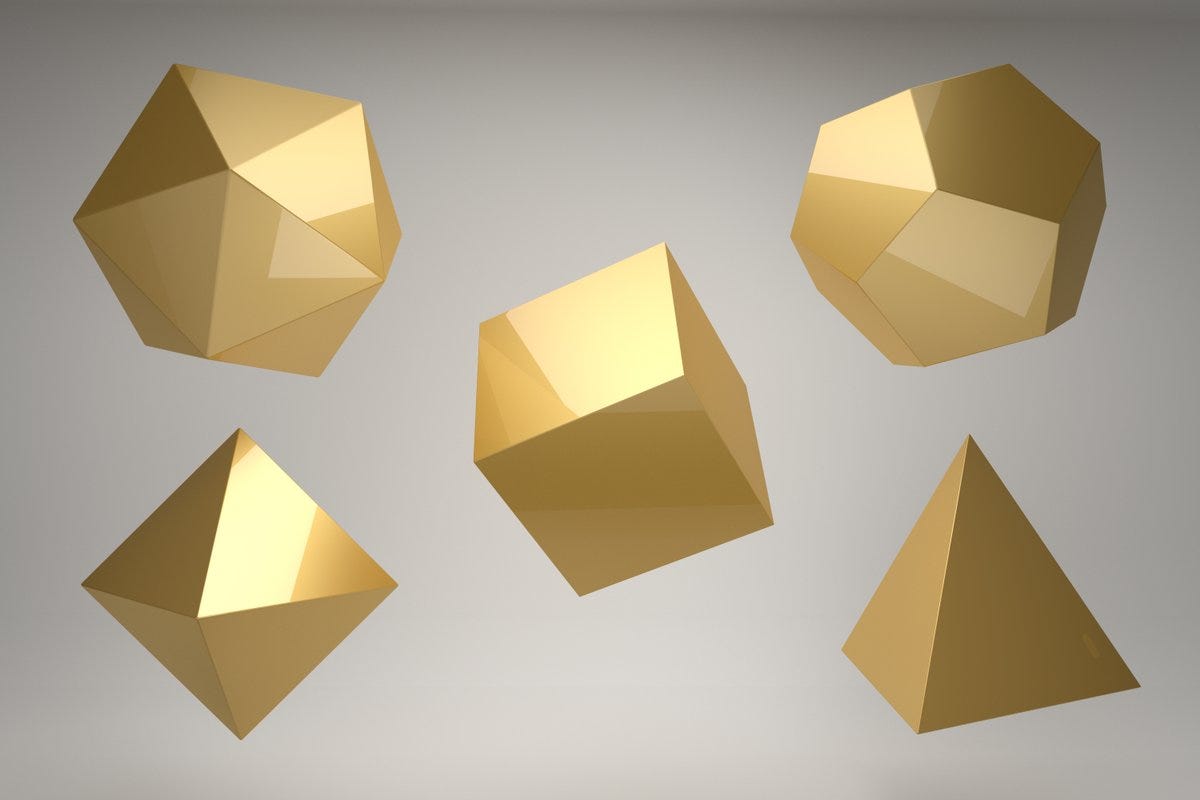
But logic doesn’t stop with π and the angles of a triangle. As the laws play out, do they produce anything more complex? Levin thinks so. He argues that the space of possible minds emerges within the Platonic space of logic.
His lab has already shown that certain mathematical objects — like sorting algorithms and simple gene regulatory networks — behave like intelligent beings when you put them in the right conditions. And that’s without delving into the insanity of large language models. Were you surprised to learn that linear algebra can learn how to paint, program video games, and write poetry? I was surprised. Perhaps Michael Levin wasn’t.
In this sense, minds — like π and triangles — are not bound to bodies. They exist in Platonic space. Here’s the analogy Levin uses to describe their relationship to physical systems:
Imagine a world in which the highest fitness is achieved by a specific shape of a triangle. Evolution spends N generations finding the first angle, and then it spends ~N more generations optimizing the second angle. But then something magical happens—it does not need to spend time finding the third angle—in flat space, if you know two of the angles of a triangle, you know the third.
The third angle didn’t evolve. So where did it come from? Well, from Platonic space — evolution produced a physical system that drew down a preexisting mathematical pattern. To understand the ultimate properties of that system, biological explanations aren’t enough. You need to consider how the system is interfacing with the Platonic space.
Similarly, the Xenobots didn’t evolve. So where did they come from? According to Levin, they’re just like the triangles — evolution produced a physical system (the frog cell) that can draw down different patterns from Platonic space, depending on the conditions in which it finds itself. For the evolutionary triangles, we can explicitly define the pattern they’re accessing; for the frog cells, we’re not quite there yet. But the same principle applies.
And so it goes for all physical systems that manifest as minds. Levin argues that cells, the nervous system of C. elegans, human brains and all the rest instantiate the cognitive patterns that already exist in Platonic space. Evolution doesn’t hardwire fixed solutions for particular environments. Instead, it builds flexible interfaces that can access the “free lunches” available from logic.
A Natural History of the Cognosphere
Is Levin right? I think so. Only time will tell.
But for the sake of argument, let’s say he’s right. The space of possible minds is vast and constrained by logic rather than physics. Physical systems (like brains) can draw down minds from that space.
In this light, one major implication of his experiments is that if you change the conditions under which these systems operate, they’ll draw down minds that you don’t normally see. Bump a sorting algorithm the right way, and it starts displaying delayed gratification. Pull frog cells out of an embryo, and they’ll coordinate to form a totally new kind of organism. Perturb an interface that usually instantiates one set of cognitive patterns, and you may convince it to go hunting in the Platonic space for another set entirely.
The human brain follows the same principles. You are a mathematical pattern. The interface in your head points into Platonic space and draws down the mind best adapted to its normal conditions. I think the basic structure of this pattern is what you notice when you meditate. Once you filter out the particular thoughts and sights and fears that distinguish your mental life from everyone else, there is the same logical pattern behind it: a human self.
So what happens when you disturb the interface — for instance, by taking a psychedelic drug? Probably the same thing that happens to Levin’s frog cells, sorting algorithms, and gene regulatory networks when you mess with them. They point somewhere else in the Platonic space and draw down another kind of mind.
I think this is why psychedelics trigger encounters with otherworldly entities. Perturbed by these compounds, your brain doesn’t just collapse into a seething mass; it points back into Platonic space and instantiates new minds that can best organize the system under its new conditions.
In other words — when we enter altered states of consciousness and see ancestral spirits, tiny people, and machine elves, we’re seeing the other patterns our brains can draw down from the Platonic space of minds.
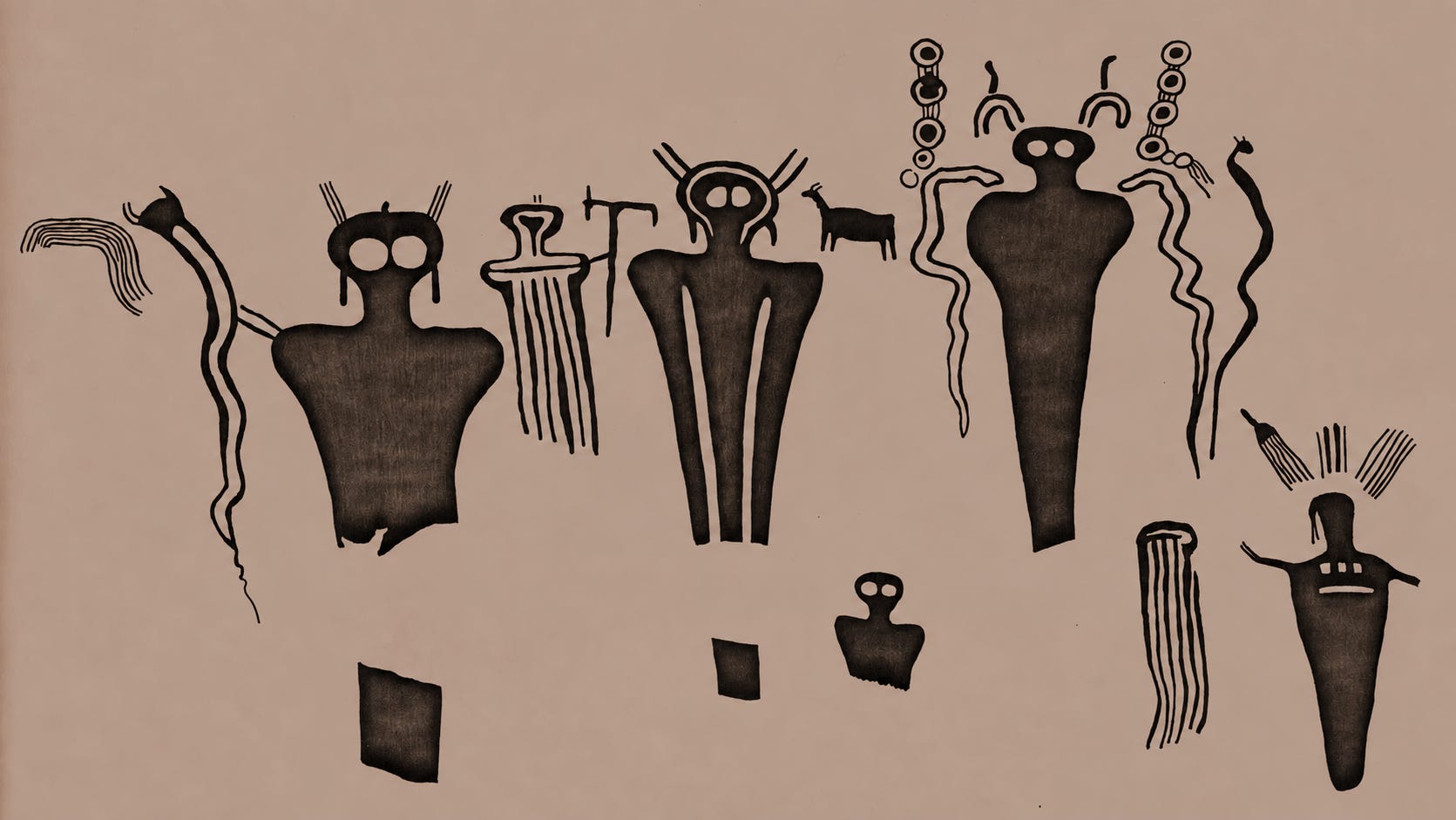
Just as frog cells don’t normally turn into Xenobots, our brains don’t normally instantiate these unfamiliar minds. It takes a special push for any system, whether embryonic frog cells or a neuronal mess, to point into other regions of logical space. But when they do, the minds they draw down are just as real as our own. Everyone’s coming from the same Platonic plane. We just don’t get to meet each other very often.
If I’m right, then psychedelics — as well as other methods for inducing altered states of consciousness — can help us peer into and detail the space of possible minds. Just as we once carried out a natural history of our biosphere, we could now carry out a natural history of what we might call the cognosphere. Maybe I’m biased, but that seems like the most interesting project in the world.
If we want to use that natural history to understand the structure of the cognosphere, we need to explore widely. How impoverished would our understanding of Earth’s lifeforms be if we had never explored the ocean? That means employing many different methods for surveying the space of possible minds: sensory deprivation, DMT, and trance dances are all valid scientific tools. We don’t want to miss out on the noospheric equivalent of a platypus.
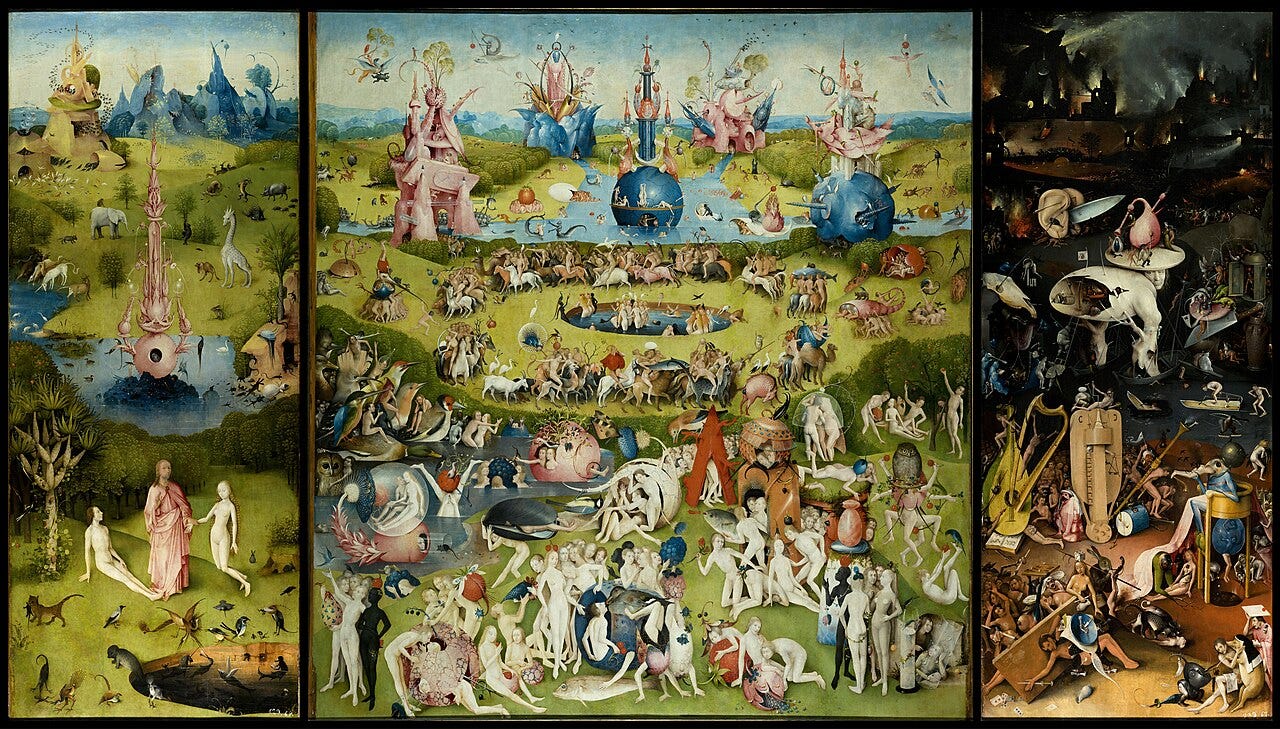
Does this all sound crazy? Maybe. But there are holes in spacetime that swallow light, and tiny beings welding together into organisms that have never existed, and creatures that can learn how to wield the power of the sun. Ignoring crazy ideas is a good way to never understand anything at all.
So I hope you won’t rule this one out, just because I’m telling you that gods might actually be real. I also hope you’ll follow Levin’s example, take his theory seriously, and if you find it compelling, figure out the other crazy ideas that follow. There is so much left to do.
For another version of this explanation, check out the fascinating work of Andrew Gallimore. I think what I’m proposing is distinct, at least in its ontological machinery, but I certainly wouldn’t be thinking about it if not for him!