

Patrick Heizer is a biomedical scientist who owns and operates Blue Glade Farm, a 12-acre permaculture farm in Frederick County, Maryland. In his spare time, he is a board member on the Frederick County Soil Conservation District and also writes The Counterpoint newsletter, where his goal is that you find it ‘worth reading’ rather than necessarily ‘being right.’
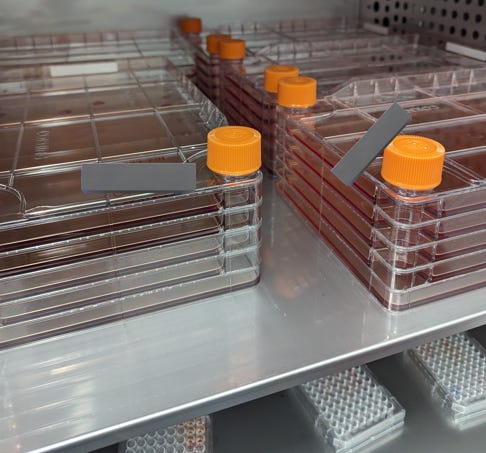
By day, I am a biomedical research scientist at AstraZeneca working on the development of cell and gene therapies. One of the many things that I like about my job is that I get to perform cell culture at a larger scale than most scientists. While the most common cell culture materials are the 96-well plate (~200uL per well) and the T175 flask (~40mL per flask), I regularly work at the liter scale.1
I came to science through a somewhat unusual path: my paternal grandparents were full-time dairy farmers in the Shenandoah Valley. My father is a bovine veterinarian who operated a small cattle farm, which I grew up on. Today, I own and operate a small permaculture farm centered around a chestnut silvopasture system with diverse supporting elements such as a pawpaw orchard, multiple beehives, living hedgerow windbreaks, and persimmon fodder.
This is a long way of saying that, whether it’s inside a biosafety hood or out on the farm, I’ve spent and spend quite a long time thinking about both cell culture, agriculture, and the systems that support both of them. So let me be clear:
Cell culture-based systems should not serve as the foundation of our meat production system and it’s really quite absurd that anyone believes that they should.
Criticisms of “lab-grown” meat are often about the feasibility of the technical science required and its eventual economic competitiveness (see this article in The Counter, or this recent episode of the Dwarkesh podcast, or this life-cycle assessment from UC Davis). Both avenues contain very legitimate concerns (so keep that in the back of your mind), but we should grant that they could very well be solvable problems. Human ingenuity has a way of solving technical problems, and anything can be made cost competitive given the right set of policies and the political will to implement them.
That is why I want to approach this topic differently and focus on the fundamental, systems-level reasons of why lab-grown meat shouldn’t be anything other than a niche product, even if many of the technical and economic hurdles are overcome.
The CAFO Problem
Let’s immediately get this out of the way: criticisms of cell culture-based meat should not be interpreted as a defense of the current industrial confined animal feeding operations (CAFOs) and the systems that support them.
The worst CAFO methods are torture, they contribute to both pandemics and antibiotic resistance, and they actively damage our environment and ecologies, from polluting waterways in the United States to cutting down the Amazon rainforest in Brazil. Lab-grown meat advocates are exactly right when they say that we need a new system for producing meat. But identifying the worst excesses and sins of the current system doesn’t automatically mean that your preferred system should be prioritized. In fact, many of the fundamental problems of CAFOs also apply to lab-grown meat.
Both systems suffer from a common deficiency of modern thought: an overreliance on narrow, reductionistic, detail-oriented thinking at the expense of holistic, systems thinking. Lab-grown meat proponents miss the forest for the trees.
Animals Aren’t Just Walking Meat Factories
Advocates for lab-grown meat love to discuss how cell culture bioreactors are more efficient at producing meat than animals (more on this later). Yet this is a prime example of these reductionistic blinders; animals don’t just produce meat but also hundreds of other useful products. A direction comparison of just lab-grown meat to conventional animal meat misses the expanded industrial production of synthetic substitutes that would be required to replace the litany of other products that come from animals.
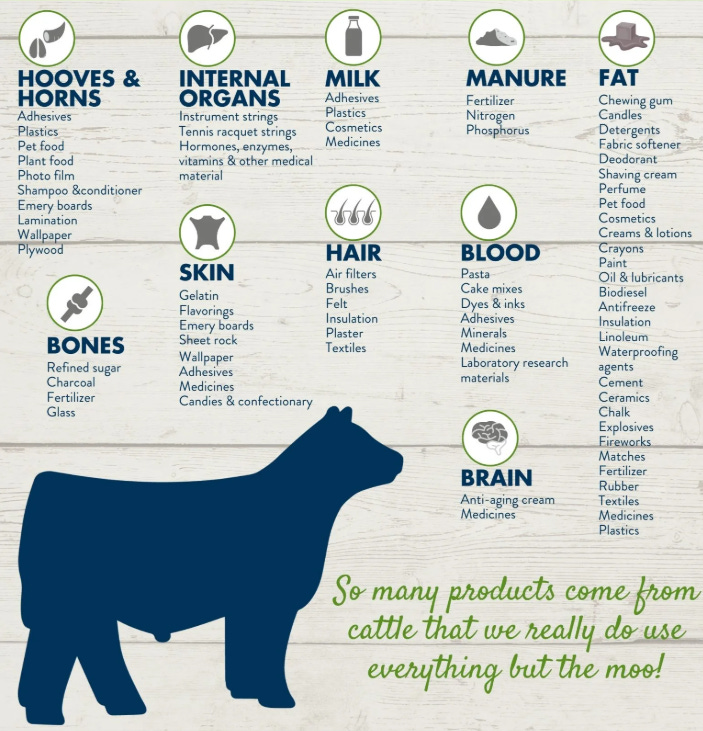
Some examples: without sheep, we wouldn’t have wool, and would have to plant more acres of cotton and flax, or use more oil to create synthetic fibers like polyester. Without dairy animals, we’d have to plant more acres of almonds, oats, and soy, to use as feedstocks for the increased production of plant-based milks. Without animal hides, we’d have to use more oil to increase production of synthetic leather. Without animal hooves, we’d have to build and supply industrial cell culture factories that specialize in the production of keratin, not only for human supplementation and cosmetic products, but also specialized applications like as an ingredient for fire extinguisher foam.
A holistic, system-level analysis must account for the multitude of products that come from conventional animal farming, not just meat.
Animals Aren’t Just Walking Product Factories
But if we’re really thinking at the systems level, even that isn’t the proper comparison. Animals aren’t just walking product factories; they also perform valuable ecosystem services.
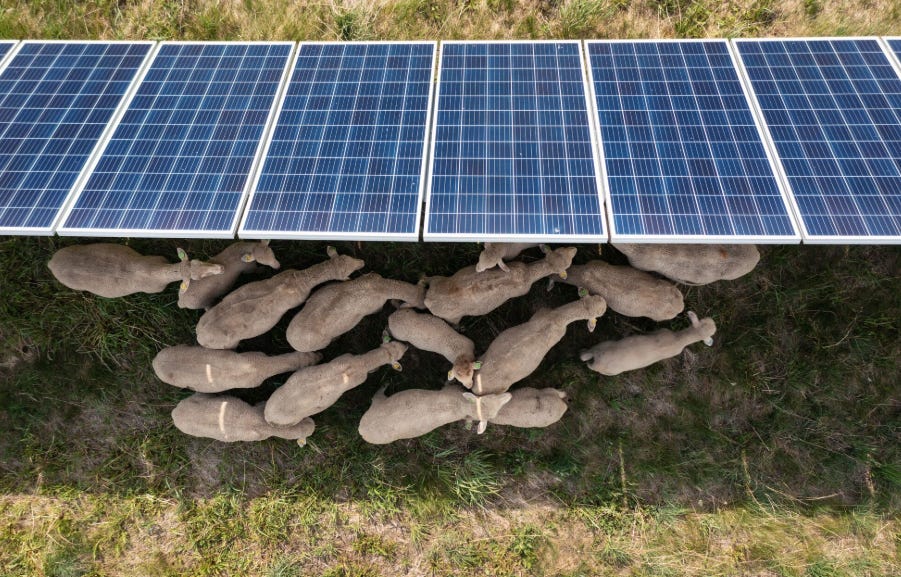
Solar energy will be a critical part of the transition away from fossil fuels, and solar fields are rapidly being constructed around the globe. Once constructed, a major aspect of their maintenance is keeping them mowed so that plants don’t grow to shade them. Typically this requires multiple passes per year with fossil fuel-consuming mowers. But one promising “innovation” that is being implemented around the country is farmers partnering with solar fields to graze them with livestock.2
Consider what is going on here: solar grazing turns inedible plant materials into both usable food and fiber while displacing fossil fuel use that would be required to maintain the site. And it also doesn’t “use” land as the solar field is already constructed and occupying the area.
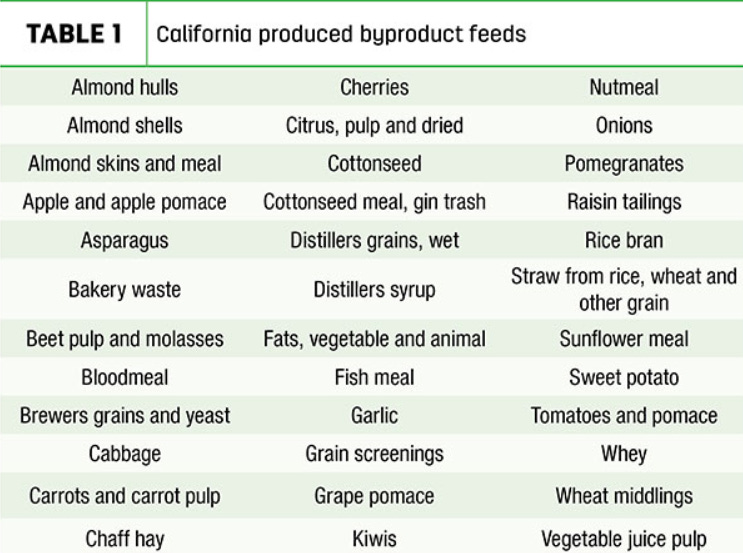
This conversion of inedible plant materials into usable products is one of the main uses of animals. Below is a table of California-produced byproducts used as feed for dairy animals. Consider the above section: if we eliminated animal milks, we’d have to expand our acreage of almonds to meet the demand for plant-based milks. That expansion of the almond industry would produce many more almond hulls, shells, skins, and meal. Without animals, those inedible parts of the almonds would go to waste.
Of course, we could compost them into fertilizer, but animals already do that too: manure (and urine).
Animal manure helps fertilize nearly twenty million acres in the United States, and many more globally. Without it, production of nitrogen fertilizers, which already consume ~2% of the world’s energy supply and produce ~2% of global emissions, would have to be expanded. And fossil fuel-consuming machinery would have to be used to spread that synthetic fertilizer onto fields, while animals can spread manure themselves.
Moreover, unlike synthetic nitrogen fertilizers, manure creates a cascade of ecosystems services. Manure supports the life cycles of dung beetles, many species of flies, and coprophilous fungi. These species not only directly provide the ecosystem service of manure management (dung beetles alone are estimated to save farmers $380 million annually) but they also create a cascade of life and other ecosystem services (e.g. birds eat flies while also spreading seeds and fertilizer themselves). Synthetic fertilizers not only consume vast amounts of fossil fuel-energy in their creation and spreading, but they don’t create any of the habitat or ecosystem services that manure provides.
Lab-grown Meat Kills Animals, They’re Just Ones You Don’t Care About
Drive by a freshly-harvested monocrop field and you’ll often see buzzards and vultures circling. See, the industrial monocrop farming required for lab-grown meat kills many animals; they’re just probably ones you’ve never considered.
Cells don’t just grow on their own; they are primary consumers, just like animals, meaning they have to eat. In cell culture, that is done by growing them in “media,” a nutrient-rich broth of glucose, amino acids, salts, micronutrients, and various other molecules, like vitamins and hormones, as well as buffers to keep everything at the proper pH. This media must provide everything that the cells require for life and growth that they cannot synthesize themselves.3
Each of the hundreds of different molecules would be an interesting rabbit hole to explore (if interested, here and here are good articles)4 but for now, let’s consider the two big ones: glucose and amino acids.
Glucose is the main energy source for cells in culture and they need a lot of it; almost all cell culture media contains pre-diabetic or even diabetic levels of glucose. That glucose is produced primarily by amylase digestion of plant material, usually corn, wheat, and potato starches.
Amino acids are the building blocks for proteins and serve as both the main carbon and nitrogen source. These days, most industrial amino acids are produced by microbial fermentation, but that just pushes the question back one step: where do those microbes get their nitrogen from? Almost all nitrogen on Earth resides in the atmosphere as a gas, and only enters the biological world by two processes: fixation by microorganisms, most commonly those that have formed symbiotic relationships with legume plants (e.g. soybeans) or synthesis of ammonia through the Haber-Bosch process (i.e. burning fossil fuels).
In other words, the only way to produce the gross tonnage of cell culture media that would be needed for lab-grown meat would be to perpetuate our reliance on industrial monocropping. This system is not only wholly dependent on fossil fuels (more on this later), but it also kills many animals; they’re just not cute, fuzzy, stereotypical farm animals.
Modern industrial agriculture equipment is massive and its operation ruthless. Tractors, combines, and plows run over and kill all the various surface organisms you’ve probably never considered: mice, rats, voles, snakes, groundhogs, ground-nesting birds, weasels, ferrets, moles. Sprayers unleash genocide with their synthetic pesticides and fungicides, immediately reducing both insect and fungal biodiversity plus cascading effects (what will birds and bats eat without bugs?). Maximal applications of fertilizers contribute to hundreds of aquatic dead zones, killing fish and nearly all non-algal marine life, with many being the size of of some US states. And while it’s not outright death, environmental exposure of pesticides has been linked to negative effects on human health, especially neurodegenerative disease and in utero effects, leading to birth defects and infant mortality.
And of course, they aren’t animals, but it should be noted that nearly every single tree in the Midwest is subjected to herbicide contamination, reducing their health and vigor.
Because of its constant demand for human-provided glucose and amino acids, a system of lab-grown meat would perpetuate the system of industrial monocropping and its deleterious effects, killing countless numbers of hundreds of species in the pursuit of the perfect, sterile petri dish to maximize the growth of corn and soybeans as feedstocks for bioreactors.
If you truly wanted to minimize the total number of animals killed as an omnivore, you’d purchase fully grass fed-and-finished beef or bison and/or venison from hunted deer or elk.
Jevon’s Paradox
While some lab-grown meat advocates acknowledge the reliance on industrial monocropping, they claim that it will still cause an overall drop in cultivated cropland. Yet they also claim, that through economies of scale and technological advancements, cell culture-based systems will produce animal products more efficiently than conventional animal farming. With more efficient use of land and resources, lab-grown meat will have a lower cost at checkout, many people will simply convert to lab-grown products for financial reasons.
But this just sets up Jevon’s Paradox: increased efficiency in resource use causes greater overall consumption of that resource. Even if cell culture-based systems use less resources than an equivalent animal-based system, those efficiencies will be rapidly lost as total meat consumption increases.
This is compounded by the fact that lab-grown meat will cause many current vegans and vegetarians to become meat-eaters. While only a low single-digit percentage of Americans are either vegan or vegetarian, globally, it is approximately 10%. Even if only a portion of these people begin eating meat, that represents tens of millions of new meat eaters, contributing to a deterioration of any “efficiency” gains.
If lab-grown meat uses 50% of the cultivated cropland than conventional meat, but causes total meat consumption to double, then there will be no reduction in cultivated cropland.5
Frames Of Reference and Wide-boundary Efficiency
To quote David Friedberg from an episode of the All-In Podcast6 (the lab-grown meat portion starts at ~48 minutes): “The biophysics of a single cell making [protein] is better than the biophysics of an animal. Think about a chicken; it grows feathers, it clucks, it walks around, it has energy, it makes heat. The chicken as a system is not that energy efficient.”
What is being referenced here is the trophic cascade. Because organisms have to spend energy on their homeostasis and maintenance, there is an approximate ~90% loss of energy as heat between layers (below). For example, it takes ~10 calories of grass or corn or almond hulls to produce ~1 calorie of beef, etc. Lab-grown advocates love to cite this “inefficiency,” yet this might just be the quintessential example of this narrow, reductionistic thinking that dominates our culture, because while accurate, it’s a biophysical sleight-of-hand.
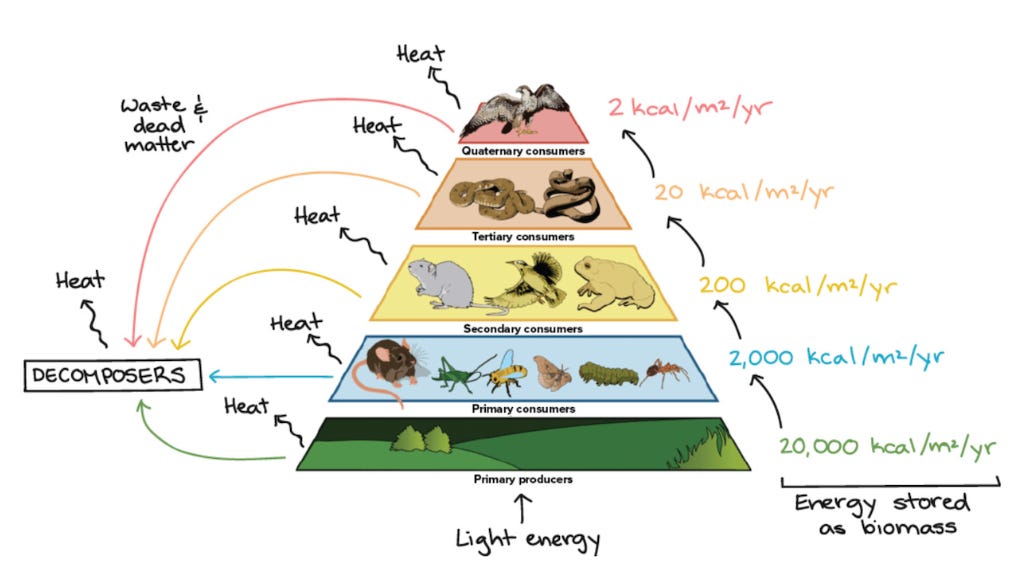
In the narrow sense, cells are indeed more efficient at making edible protein than animals. But this “efficiency” isn’t because cells don’t have homeostasis and maintenance requirements, but because humans do it for them. Bioreactors have to be kept at the proper temperature, nutrients have to be properly circulated through mixing, gases pumped in and out to ensure the proper respiratory rates, and heat, antibiotics, and/or filters used to maintain sterility. With significant amounts of human-provided energy, we ‘baby’ the cells, allowing them to focus on solely on growth.
Meanwhile, an animal using protein to maintain homeostasis necessarily lowers their relative edible protein production, but from the frame of reference of humanity, all those homeostatic functions come for free. Humans have to expend large amounts of energy to keep bioreactors sterile, while cows keep themselves (internally) sterile with their immune system, etc. This is the sleight of hand: yes, the total amount of energy spent on homeostatic functions might be lower with a bioreactor, but all that energy come’s from humanity’s energetic balance sheet.
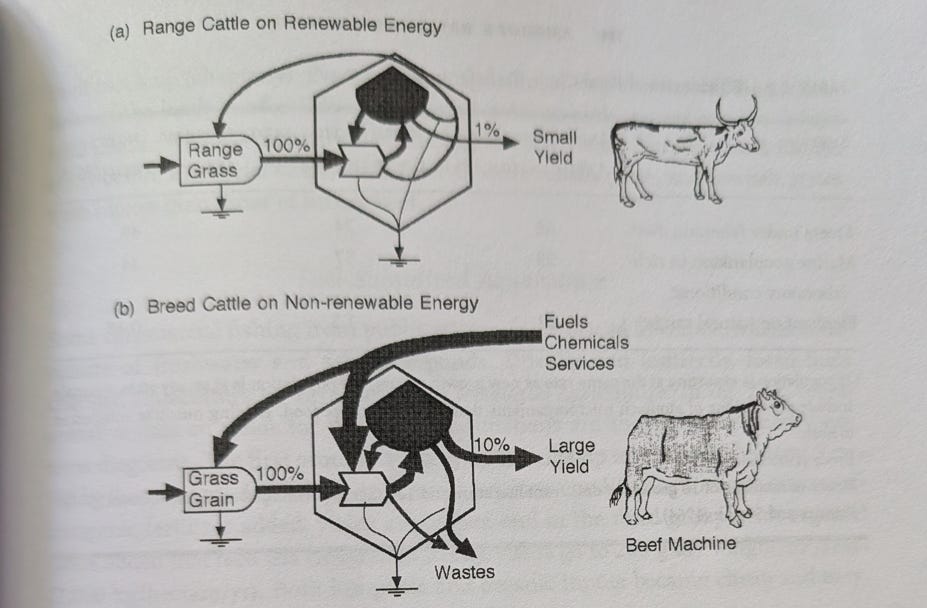
These human-provided external inputs underlie a deep confusion present in many agricultural discussion: the difference between productivity and efficiency. Agriculture has always been about increasing productive yield by application of external inputs, whether human labor or diesel machinery. But increasing external inputs by 1,000x for a 10x yield isn’t “efficient,” we do it because it is productive, and productivity is a variable of life-and-death importance (malnutrition and famine are awful!).
Often times, people will try to focus on narrow efficiencies (output per a single variable), e.g. feedlot cattle take less time to raise than grass fed-and-finished (kilograms of beef per time). But this narrowing of the aperture misses all the other variables that it takes to produce feedlot cattle (concrete, diesel, feed, etc.), all of which humans must provide. Meanwhile, those same cattle could’ve just been living on pasture, living happily with several orders of magnitude less human-provided inputs.
From a systems perspective, we cannot be more efficient than nature because nature happens for free. For example, a synthetic wood factory might very well be more productive than a forest (more output of wood per area) and it might very well have narrow efficiencies (e.g. less water used per output of wood), but it cannot be more wide-boundary efficient, because wood, quite literally, “grows on trees” and rain falls from the sky. We don’t have to do anything for a forest to grow. Moreover, the forest provides many ecological services (synthesizes oxygen, supports biodiversity, prevents erosion, etc.) that aren’t accounted for when only narrow efficiencies are considered.
Lab-grown meat requires an extraordinary amount of human-provided inputs, necessarily lowering it’s wide-boundary efficiency compared to naturalistic forms of meat production.
State vs Path Properties, and How Potatoes Are Made Out Of Oil
Lab-grown meat advocates also love to tout how cell culture-based system have lower greenhouse gas emissions than conventional meat. But this is a deep misunderstanding of the root cause of climate change, and even more fundamentally, a confusion of state and path properties.
Imagine that you are car shopping and that there are two identical cars sitting on the lot. They are the same make, model, production year, and were even produced at the same factory and delivered to the dealership at the same time. Heck, even priced the same. Are they the same car? You think so, until after you sit in both and notice that the odometer of one has a thousand additional miles; it is being used as the test drive car for that make and model. While the state properties of both cars are the same, their path properties are different.
State properties depend only on the current condition of a system, not how it got there. Consider the engine temperature, tire pressures, or steel content of the cars. It doesn’t matter that one car has been driven more that the other; temperature, pressure, and mass are direct measurements of state; they are what they are. In contrast, path properties depend on the “path” the system took to change states, like the odometer, which computes all the prior work that the car has done. State properties describe the “what,” while path properties describe the “how” of a system’s transformation.
This is important because even if lab-grown meat has lower emissions than natural meat, it could very well be making a greater contribution to climate change despite those lower total emissions. While every kilogram of carbon dioxide or methane or nitrous oxide has the same state properties (one kilogram is one kilogram), not all emissions have the same path properties. This is important because climate change is rarely fully explained properly.
The terrestrial biosphere has three compartments (land, ocean, and atmosphere) that are in constant equilibrium with each other. There are millions of interactions that underlie that equilibrium, and they are in constant flux, but the net result was an atmospheric concentration of carbon dioxide that oscillated within a narrow band for roughly the last million years. Until industrialization, that is.
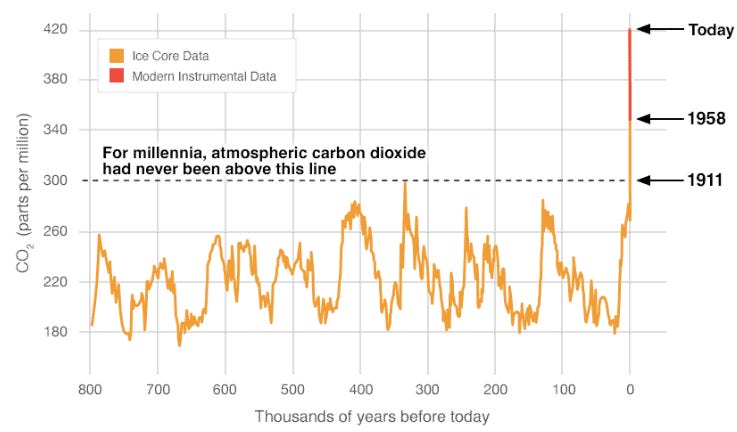
See, there is a fourth compartment on Earth: subterranean. Now, the subterranean compartment is also in equilibrium with the terrestrial compartments through things like volcanoes, aquifers, and hydrothermal vents. But much of the mass of the subterranean compartment isn’t in equilibrium; it is sequestered and doesn’t really interact with the biosphere.
The fundamental cause of climate change isn’t “carbon emissions” but rather humanity increasing the total carbon load of the terrestrial biosphere by liberating hundreds of billions of tons of previously-sequestered subterranean carbon.7 This is why the ocean is acidifying, rates of photosynthesis are increasing, and atmospheric levels of carbon are rising all at the same time: we are increasing the total amount of carbon circulating in the terrestrial biosphere, forcing increases in each of the three compartments.
This is important to understand because, just like how, in one of the most famous scenes from The Wire, Lester Freamon implored his fellow officers to, “follow the money,” I’m asking you to follow the atoms.
There is no doubt that livestock emit greenhouse gases. All animals produce carbon dioxide through their respiratory system and methane through their digestive system, the latter being especially true of ruminant digestive systems, such as cows, sheep, and goats. But when raised properly, all they are doing is participating in the biogenic carbon cycle: cycling carbons through the three compartments of the terrestrial biosphere. This is why the atmospheric level of carbon dioxide stayed within that narrow band despite humans burning firewood and mega herds of bison, wildebeest, water buffalo, and elk roaming the continents. Those were just cycling already-terrestrial carbon atoms and Le Chatelier’s principle applies.
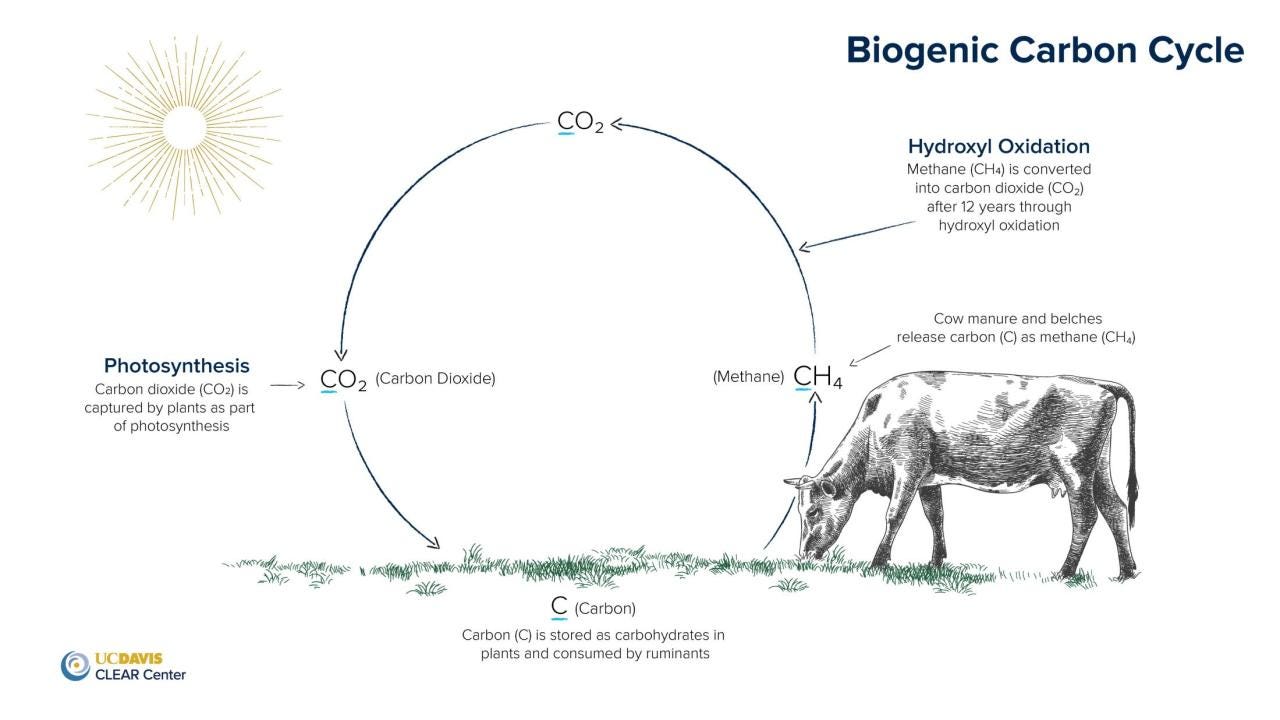
It is the liberation and introduction of sequestered carbon into terrestrial circulation that is the fundamental cause of climate change, and yes, modern industrial CAFO systems contribute to it. Go back to the efficiency section and note the energy flow diagram with the two cows: the modern one with the higher productive yield is achieved through the addition of “fuels, chemicals, and services.” In other words, fossil fuels.
But that exact same logic applies to lab-grown meat.
If you account for the path properties, any system that uses fossil fuels is a greater contributor to climate change than one that doesn’t, even if the later has more overall emissions. See, it is very easy to explain how to raise livestock without fossil fuels; it was done for over 10,000 years. Yet it is currently impossible to produce lab-grown meat without a significant amount of embedded fossil fuels.
(Not to mention, there is some dispute about total emissions from lab-grown meat; they very well might be outright higher than conventional beef.)
Oh, and the State Properties Aren’t the Same Either
With tens of billions of dollars of investment and decades of research, cell culture-based systems and the post-processing of their products may very well result in various products which have the taste and texture of meat. But they will never be actual meat.
Meat is not a Platonic form. It is a complex, three-dimensional structure of a multitude of cell types and biological molecules: skeletal muscle cells, smooth muscle cells, endothelial cells, collagen, bone, extracellular matrix, blood, etc. Meanwhile, simplistic lab-grown meat uses only one cell type (skeletal muscle cells), making it necessarily different from conventional meat. But even with advanced lab-grown meat, which attempts to replicate this by growing multiple cell types on edible scaffolds (i.e. even more human-provided inputs), their microstructures are not the same, and natural and lab-grown meats can easily be identified under a microscope.
Moreover, this complex structure doesn’t just sit there, it receives biomechanical and hormonal feedback from the organism itself. There is a reason that veal tastes different than beef, that beef usually comes from steers (castrated males) not bulls (non-castrated males), and that even within the same animal, the taste and texture of the various cuts are different. Muscles are a complex tissue that receives feedback from the organism itself, and aren’t just static cells that grow in a bioreactor.
Finally, this complex structure subject to biomechanical and hormonal feedback is also subject to environmental “terroir.” There is a reason that Iberian ham and Ortolan Bunting are considered delicacies; the exact methods in which they were raised affects the meat’s final taste.
This is yet another sleight of hand; lab-grown meat producers will use many tools to recreate the exact taste and texture of conventional meat, but they are not creating actual meat.8
Let’s Stress the Grid Even More
Okay, this one is more of a technical problem, but it’s one that I’ve never seen mentioned: where is all the electricity going to come from?
Global electricity consumption has tripled from ~10,000 TWh to ~30,000 TWh over the last forty years. And with the proliferation of data centers to power the modern internet and LLMs, decarbonization efforts such as switching cars to EVs and conversion of older HVAC systems to electric heat pumps, the increasing number of electric appliances and devices in the home and office, and continuing economic development across the globe, the world is going to have to continue to rapidly increase the supply of electricity.
Yet the United States is struggling to keep up with demand, our grid is aging and needs replaced, and you’ve probably noticed your electricity bill rising faster than overall inflation.
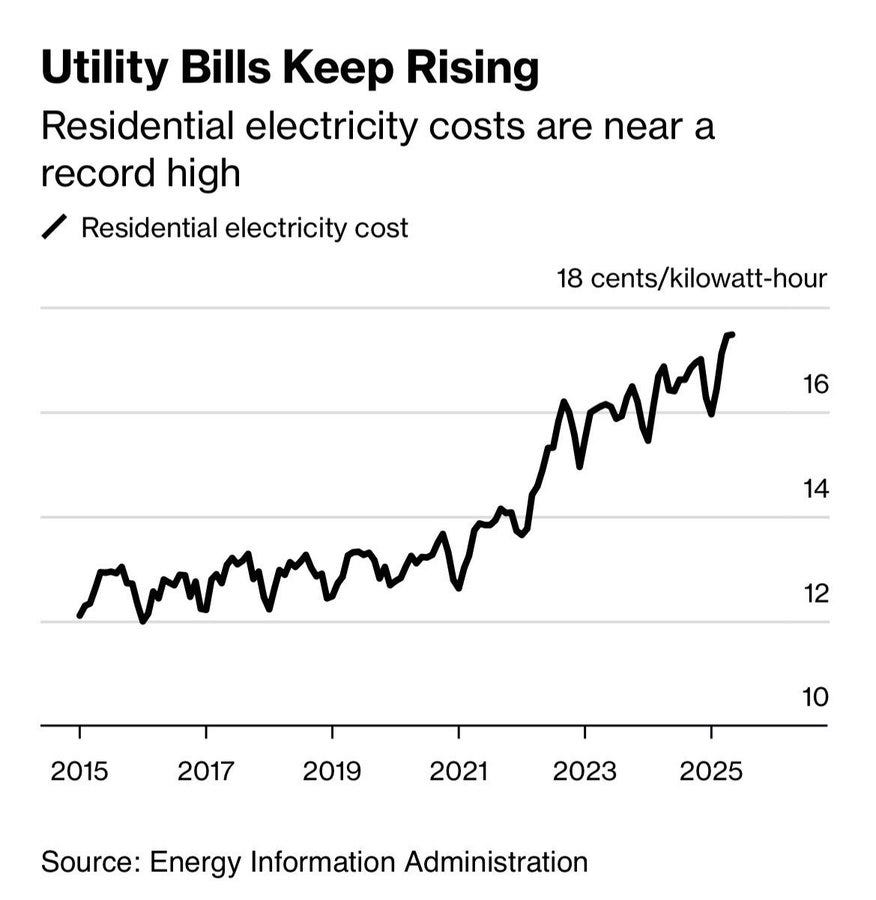
Lab-grown meat would just add another straw to the camel’s back. The industrial warehouses, the lighting and climate control, the filtration and purification of the solid, liquid, and gaseous inputs, the mixing and moving of both inputs and outputs, the stirring and heating of the bioreactors, the sterilization of all the different components and parts… All of this requires energy, primarily electricity. Where is it going to come from if both our electricity production systems and grid are already struggling?
Centralized Corporate Oligarchs
Anyone reading this could very easily learn to raise, slaughter, and process animals, while it would be impossible for you to build and operate a cell-culture bioreactor.
Agriculture is already one of the most consolidated industries and lab-grown meat would simply consolidate it further. Due to the inherent production complexities, intellectual property, and economies of scale, lab-grown meat would be owned by a small group of vertically-integrated corporate oligarchies.
System Fragility
This centralization of meat production into a small number of facilities would greatly increase the fragility of our agricultural system.
What if production is halted at one of the biggest facilities because of contamination, like what happened with baby formula a few years ago, leading to empty shelves nationwide? What if something happens to the supply chain of feedstocks causing facilities to idle? What if a coordinated terrorist attack outright shut down several of our facilities at once? Shifting the majority of our animal protein production into a small number of facilities greatly increases the societal risks.
This problem is compounded by the fact that any remaining animal herds would be smaller and couldn’t be increased overnight. As the old adage goes, “Nine women can’t make a baby in a month.” A major factor in the current rising cost of beef is that the American cattle herd is the smallest it has been in 75 years. It is an explicit goal of lab-grown meat advocates to reduce the size of American livestock herds and flocks, and while that very well might achieve other objectives, it exponentially increases the fragility of overall food system.
Depreciation Is a Real Expense
A lab-grown meat system would require a network of industrial warehouses and on-site supporting systems, with much of them not only climate controlled but actual clean rooms. Cell culture systems require sterility, not only of the components being injected into the bioreactor systems, but of all the bioreactors and pre- and post-processing equipment. From the previously linked article from The Counter:
The Open Philanthropy report assumes the opposite: that cultivated meat production will need to take place in aseptic “clean rooms” where virtually no contamination exists. For his cost accounting, Humbird projected the need for a Class 8 clean room—an enclosed space where piped-in, purified oxygen blows away threatening particles as masked, hooded workers come in and out, likely through an airlock or sterile gowning room. To meet international standards for airborne particulate matter, the air inside would be replaced at a rate of 10 to 25 times an hour, compared to 2 to 4 times in a conventional building. The area where the cell lines are maintained and seeded would need a Class 6 clean room, an even more intensive specification that runs with an air replacement rate of 90 to 180 times per hour.
Now not only does this consume vast amounts of energy but it means something that is rarely considered: depreciation. Aside from all the energy and resources required for building the facilities and ongoing operation and maintenance, these facilities will degrade over time. Not just the regular replacement of components like tubing and filters, but the actual bioreactors and buildings themselves. Warehouses last decades, maybe a century, before they require demolition and rebuilding, leading not only more energy expenditure in waste and processing, but another round of building.
Meanwhile, a stewarded and maintained perennial grassland and savannah silvopasture systems continually appreciate over centuries and millennia, with no rebuilding and replacement required.
Agroecology Is the Real Solution We Should Be Prioritizing
Perhaps the most fundamental problem with lab-grown meat is that it is a distraction, siphoning people, money, time, and resources away from the real solution to agricultural sustainability. Humanity needs to be using this time of high-energy domination with industrial agriculture to catalyze our transition toward being a keystone species which stewards and magnifies Earth’s natural energy flows into productive agroecology.
Now, I could write a book on this (and maybe I should?). There is much to say about historical, current, and future systems of food production. But here is not the place to be exhaustive, so I will try to be brief. I will start with two things about modern industrial agriculture:
First, it has done an excellent job at solving the primary problem that an agricultural system should: “feeding the world.” We have made extraordinary progress at reducing hunger and malnourishment, while famines have almost been eliminated. It has almost certainly saved more lives than any other human invention.
Second, it has numerous and significant negative externalities, many of which are unsustainable: its grossly dependent on fossil fuels and synthetic chemicals, it emits large amounts of greenhouse gases (and not just carbon dioxide), is often cruel toward its animals, causes topsoil loss, destroys biodiversity and wildlife habitat, pollutes our water and air, and prioritizes calories over nutrition.
In our current system, over 80% of all harvested calories come from just ten crops, almost all of which are annuals. Moreover, the top three crops (corn, rice, and wheat) are all specifically annual grains and together account for ~50% of all food calories.
That our agricultural system evolved around annual grain crops makes sense: you plant a seed in the spring, harvest the calorically-dense crop in the fall, and it’s easily storable for winter. This sets up a positive feedback loop of survival → iterative breeding → higher crop yields → survival that caused the agricultural evolution and, well, all of civilization.
While this was critically important for humanity when we were only a single bad season away from famine, there is growing recognition that the priorities of the modern system need to shift to ensure not only our immediate caloric needs, but also the long-term sustainability and resilience of the system itself. Now that we’ve solved the caloric problem, the agricultural question of our age is how do we solve the nutrition, sustainability, and resilience problems, while continuing to meet caloric needs.
We can do this through agroecology, an overarching term that captures some terms that you might’ve heard: regenerative agriculture, permaculture, naturalistic farming, etc. Agroecology attempts to use, amplify, and capture the ecological complexification that results from nature’s natural energetic cascade. It tries to steward nature toward food and fiber production, meeting our needs while providing ecological services, creating a permanently sustainable system that allows for both human and environmental flourishment.
At this point, you will probably accuse me of being some Luddite, utopian hippie, so I want to be clear that this isn’t a panacea; agroecology does have downsides. Again, this isn’t the place to be exhaustive, but let me briefly attempt to illustrate the downsides, while defending why they are worth it.
Agroecology Is Less Productive (And That’s Okay)
Make no mistake, in terms of caloric yield (calories per acre), there is no beating industrial systems. There is a reason that we do them. But as I’ve said, caloric production is no longer the primary problem. If anything, caloric excess is our primary problem. Every continent produces over 2,500 calories per person per day, with North America producing over 3,500 calories per person per day!
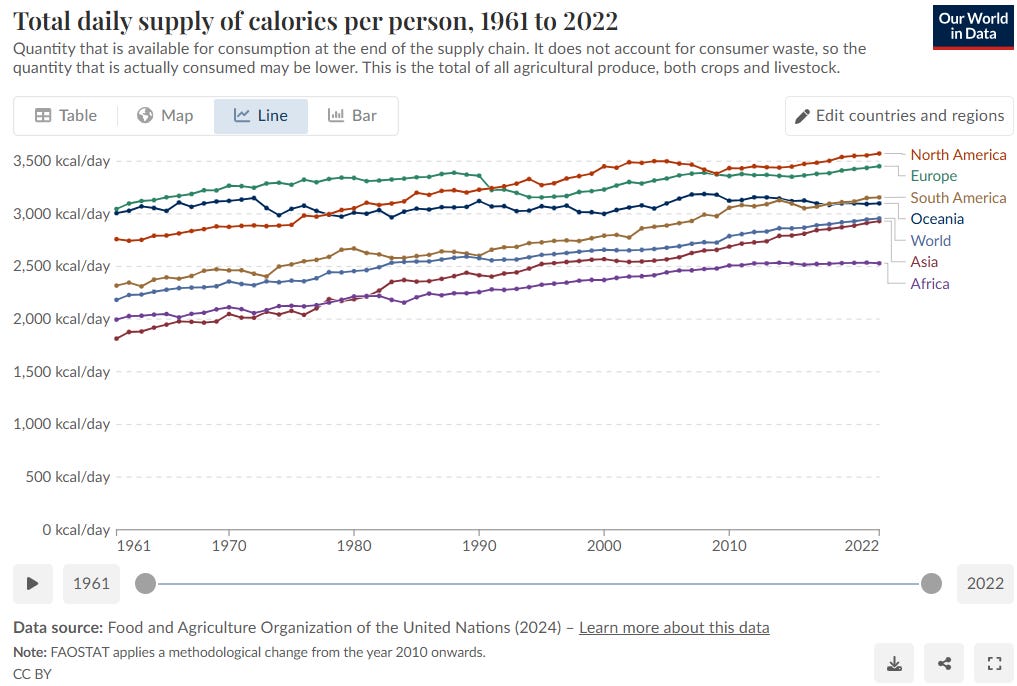
We have advanced to the point where we can “afford” for agroecological production to be less productive industrial acreage.
Agroecology “Uses” More Land (But Gently)
A lower rate of productivity means that at constant consumption, more land will have to be used. For example, White Oak Pastures, a well-known regenerative agriculture ranch, was studied and showed ~2/3rd reductions in GHG emissions (& other benefits) for the “price” of 2.5x more land use.9
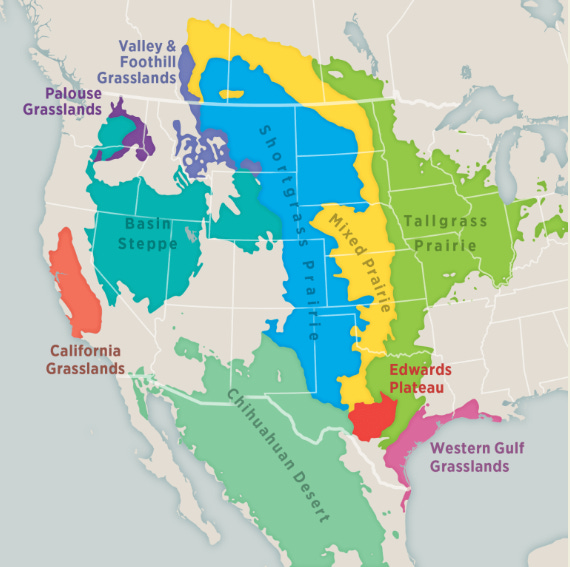
But the point of agroecology is to amplify natural ecosystems. There should be herds of bison and elk and flocks of dozens of bird species moving about the hundred million plus acres of natural grasslands in North America (below). Iowa shouldn’t be corn and soy to feed animals or cells; it should be prairie or savannah that directly nurtures animal life. Since agroecology mimics nature, it’s land “use” is exponentially gentler than industrial production.
At minimum, we could take the ~30 million acres of corn that is grown annually for ethanol production and transition that acreage into agroecological production (offsetting more than 30 million acres, because whatever food produced there would eliminate production elsewhere).
Or how about the millions of acres dedicated to feed exports? Or activities dominated by the wealthy, like horses and golf?
And it would certainly take some time, but properly-integrated silvopasture systems would eventually offset industrial logging production, as chestnut, oak, hickory, etc. trees were used as lumber at the end of their lives.
Agroecology Uses More Labor
There is no doubt about it: agroecological production will require more labor. Here I can appeal to both the Luddite and the technological accelerationist, as there is no doubt that AI and robotics will have widespread impact on society.
One one hand, perhaps advanced agricultural robotics (drones to corral rotationally-grazed animal herds, humanoid robots managed terraced slopes of rice production, robotic automatically weeding pastures and fields or thinning fruit trees, etc.) will be able to fully this demand for labor.
On the other hand, if opportunities for productive work are destroyed, people search for meaning and productive outlets. What better way to spend your time than stewarding some patch of Earth? Even in “AI utopia” the Mexican fishman is still going to fish.
At minimum, there are currently millions of people who would like to participate in agriculture; they were simply forced out by decades of American economic and agricultural policy designed to destroy family farms (“get big or get out.”).
Agroecology Is Expensive
Currently, agroecological products are more expensive.10 But they are often higher quality in ways that can “pay for themselves” over time.
For example, how is that Americans are eating more calories than ever before, yet a growing number of people suffer from micronutrient deficiencies? Because after generations of iterative breeding focused solely on caloric production, our food supply has slowly declined in micronutrient density.
There is growing and widespread acknowledgement that our food supply creates multiple health problems across society. Agroecologically-produced items may be more expensive upfront at the checkout register, but if they, say, both reduce obesity by 5% and overall healthcare expenditures by 5%, then they could pay for themselves.
There are also other impacts if you factor in enhanced ecological services. For example, try researching how much the Untied States spends annually on water treatment to clean up agricultural nutrient runoff.
We Should Continue To Develop Lab-grown Meat (At Least a Little Bit)
Now, let me say some nice things about cell culture-based food production systems, as I do think that some amount of effort should be given to developing this technology. This is because:
If successful, it could replace or eliminate highly unethical meats such as veal and ortolan bunting.
Its research and development could lead to advances in industrial-scale cell culture and bioreactor technologies, which could be useful for the production of things that don’t “grow on trees” like monoclonal antibodies and CAR-T cells.
It could serve as a nice supplement food source, especially for vegans and vegetarians, who have difficultly hitting recommendations for certain micronutrients such as B12 and iron.
As a supplement, it would serve as a buffer to increase the resilience of our food system, for example when chicken herds had to be culled due to avian influenza, etc.
Conclusions
While lab-grown meat advocates are often correct on narrowly-defined points, if we step back and use holistic, systems-level thinking, it is clear that it shouldn’t be anything other than a niche product. At best, it’s an energy-intensive distraction from a truly sustainable agriculture, at worst, a techno-optimist pipe dream that is doomed to fail and waste many resources in the process.
Rather, humanity needs to be using this time of high-energy domination with industrial agriculture to catalyze our transition toward being a keystone species which stewards and magnifies Earth’s natural energy flows into productive agroecology.
Queue scoffs and smirks from my friends that work in our manufacturing department who work on the 1,000 and 10,000 liter scale.
Typically sheep are used, as most solar fields are low-mounted. High-mounted panels are required for goats (they jump) and cattle or horses (they are bigger).
The quintessential example here is amino acids. All twenty amino acids are required for life, but most organisms can synthesize many of the amino acids within their own cells. These are called “non-essential” amino acids. “Essential” amino acids must be obtained through diet. The exact breakdown on non-essential and essential amino acids depends on the specific cells and setting.
Just to mention it within this text, one criticism of lab-grown meat is the “FBS problem.” Cells do require many, many different molecules and this is often solved by adding fetal bovine serum (FBS). FBS is exactly what it sounds like; anytime a slaughtered cow is discovered to be pregnant, her fetus is cut out, its blood extracted, and processed for serum. This serum is valuable because it contains all the essential molecules for life, while being low in immune-reactive immunoglobin molecules. FBS is frequently added to cell culture media. In short, critics will say that lab-grown meats requires an industrial slaughter industry.
My two cents is that I think this is mostly a solvable problem. Many cell types and culture systems can be acclimated to growing without serum and/or critical molecules can be synthesized and added to the media directly. At work, I grow several cell types that don’t require serum.
That I believe the “FBS problem” is solvable, is why I placed this in the footnotes, but do note that is in an outstanding problem.
I predict that someone will comment with the stat that “lab-grown meat actually uses 99% less land,” something so obviously absurd that I cannot believe it is perpetuated. Briefly, there is a massive different between “land” and “cultivated cropland.” There are large areas of the global which not only have soil so poor that they couldn’t grow crops, but so little precipitation that they can’t grow trees: they are supposed to be grasslands. And since they are typically in the middle of nowhere, they can’t serve as housing, commercial, or industrial facilities either. Having animals graze them is yes, “land use,” but is literally the most productive thing we could be doing with that land. The thousands of acres of golf courses in just Los Angeles are an exponentially poor use of land (and more resource intensive) than the millions of acres of drying grazing.
I am tempted to simply announce QED here, since if it was confidently asserted on the All-In podcast, it must be untrue.
“Carbon emissions” is a useful shorthand because they often are the primary introduction of carbon to the terrestrial system: the combustion of many petroleum products is quite useful, to say the least.
In their defense, I do think most people just care about the taste and texture of their food, not “what it is.” See the proliferation of ultra-processed foods with fancy taste additives. If lab-grown meats are able to replicate the taste and texture of conventional meat and that is all that matters to you, fair enough. I can’t dispute that.
Moreover, I don’t believe that WOP practices silvopasture techniques, which other research has called “the largest single opportunity for mitigating emissions in the beef supply chain.”
I would be remiss if I did not mention that it is not a fair playing field. Industrial production is heavily subsidized, both directly (crop subsidies and insurance) and indirectly (fossil fuel subsidies).
There's a lot of issues with this article, but most of them boil down to the fact that you're using figures about pasture-raised animals to launder a defense of factory farming (despite claiming to find it morally reprehensible!).
Many of the substantive critiques here fall apart because they're comparisons between LGM vs Pasture Ruminants on marginal land, not Industrial CAFO chicken or pig meat. The distinction between Pasture meat and Tyson is a big one! Routing crops through an animal (as in CAFO) multiplies field deaths because they scale with cultivation. A grain-fed CAFO animal therefore causes more field deaths per kg than a pastured animal grazing untilled forage. Field deaths themselves are a bizarre way to measure a welfare effect — I doubt anyone would consider the life of a vole killed via field cultivation to be anywhere near the same level of suffering as a cow captive in a factory farm.
A lot of the structural issues that you point out are contingent upon factors such as the not yet decarbonized feedstock supply chain or the currently fossil fuel reliant electrical grid. Also, relative to other stressors that drive increasing energy prices like Data Centers, EV Charging, etc. cultured meat is a small piece of the pie.
Regarding the agroecology bit, LGM meat cutting into Tyson's market share is hardly a stressor on some Iowa farmer converting corn acres to silvopasture, these economies are not as intertwined as this piece makes them out to be. To the extent that they are intertwined, the effect is reversed, LGM out-competing CAFO would lower feed-corn demand and make the transition easier.
If we assume that the shift towards lab-grown meat happens within a 5-year window some of the critiques in this article would hold true; but claiming that LGM research should therefore be de-prioritized (or done "a little bit") is nuts.
Some other brief notes:
- The FBS footnote belongs in the body of the text because its load-bearing piece in the rest of the section's argument, burying it is a bit more than dishonest
- The avian-flu example is weak, you concede that cultured meat is a resistance buffer against flock culling while still positioning it as the worse alternative
- If meat demand falls due to LGM, it doesn't mean no more animal co-products. it means that they come from animals who get longer lives, the demand for those co-products doesn't disappear. Either the price of such goods increase (which is a small price for animal welfare) or the supply of co-product oriented animals increases.
- I'd get rid of the pasture-appreciating in value bit, by that logic we shouldn't build any manufactured good
Lab grown meat and vertical farming could scale to feed hundreds of billions without covering the planet in human agriculture. One could re-wild vast tracks of ranches and cash crops acreage. The majority of your article is motivated reasoning. Having lived in Amish country for a decade, I get the wistful thinking. Unfortunately, we live in a science fiction reality and if AI goes well humanity can expand massively. If AI goess poorly, then feeding humanity becomes a footnote.