

This report reviews three years of science writing on Substack from October 2023 through September 2026. A total of 47,562 science posts from 2,785 newsletters were collected, starting from Substack’s science leaderboards and following newsletters’ recommendations outward. I looked at the fields they cover, who writes them, the people they mention, the papers and books they discuss, the questions they ask, what readers like, and how all of this evolved over the three years.
Roger’s Bacon is a writer, teacher, and co-founder of Seeds of Science.
Contents
How to cite this report: Roger’s Bacon (2026). The State of Substack Science 2026. Seeds of Science. https://www.theseedsofscience.pub/p/the-state-of-substack-science-2026
Executive summary
What this study is
A count and analysis of science writing on Substack over exactly three years, from 1 October 2023 to 30 September 2026. The years run October to September: Year 1 is October 2023 to September 2024 and Year 3 is October 2025 to September 2026. Throughout, an arrow shows the change from Year 1 to Year 3: 12% → 14% means 12% in Year 1 and 14% in Year 3. The goal was to obtain the biggest dataset I could responsibly collect. The full lists behind it (every question, person, book and paper, plus subfields and more) are in a searchable explorer at substack-science.netlify.app.
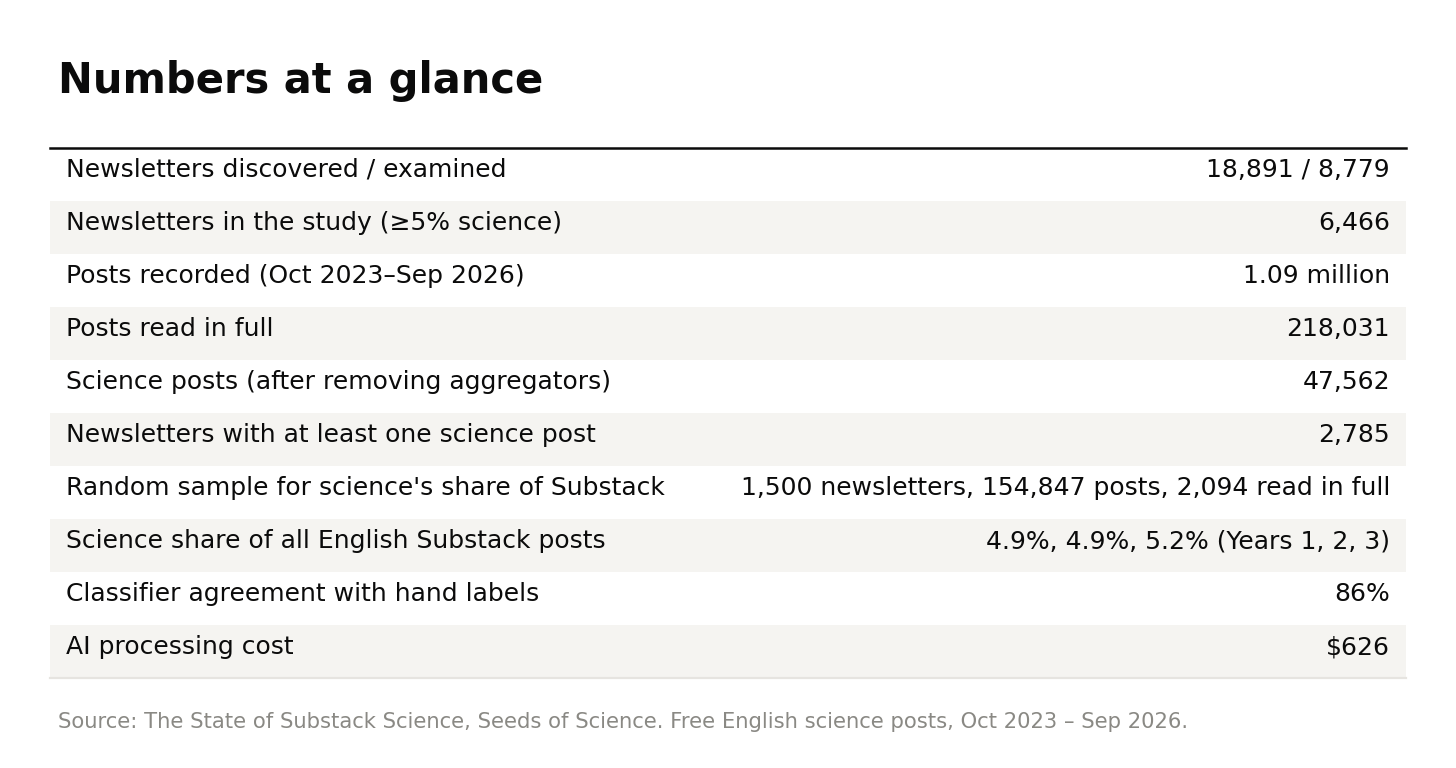
What’s in. Free posts, in English, that examine scientific research or ideas: the natural sciences, the social sciences, medical and health research, the scientific enterprise (how science is done, funded, published, communicated and trusted), and the philosophy and history of science. 47,562 posts from 2,785 newsletters (10,502 in Year 1, 14,833 in Year 2 and 22,227 in Year 3).
What’s out.
Wellness and diet advice, patient guidance, and health or science policy news without examination of research.
Pure mathematics, computer science and engineering, and AI industry news (new models, products, benchmarks).
Paid posts. I recorded only their public details (title, date, likes and comments) and never read their text, so none of them are among the 47,562 science posts.
Five aggregator newsletters that mostly repost other outlets’ news, press releases or abstracts.
Newsletters that my search never reached: I started from Substack’s Science leaderboards and followed recommendations outward, so this is a popularity-based sample of science on Substack, not a complete census.
What “AI” means here. A science post counts as an AI post when AI is a substantive subject of it: AI studied scientifically (for example experiments on how language models reason), AI used as a tool in science (for example protein-structure prediction), social-science research on AI’s effects (for example surveys or trials of how chatbots affect students), or an argument, without new research, about how AI is changing science or society (for example “Is AI really making clinical trials faster?” or “AI is making science publishing slower and more expensive”; about 2% of AI posts).
AI writing that isn’t in the study. Three kinds are out:
AI as a product or business: new model releases, company news, funding rounds and benchmark results.
AI engineering, which I treat as computer science: how models are built, trained and scaled. Research on what goes on inside models counts only when it uses the questions or methods of a natural or social science, as in experiments probing a model the way a psychologist would.
Practical guides to using AI: prompting tips, tools and workflows.
A science post that mentions AI only in passing or as an analogy stays in the study but does not count as an AI post.
The sample at a glance
What they cover: The largest category, the scientific enterprise, covers how science works (how it’s done, funded, published, communicated and trusted). Philosophy and history covers epistemology and scientific method (39% of its posts), history of science (21%), ethics and values in science (18%), philosophy of mind and consciousness (11%), and the philosophy of biology, AI and physics (3–4% each). A post can belong to more than one field; 86% span two or more. Subfields and the most common specific topics within each field are in the explorer.
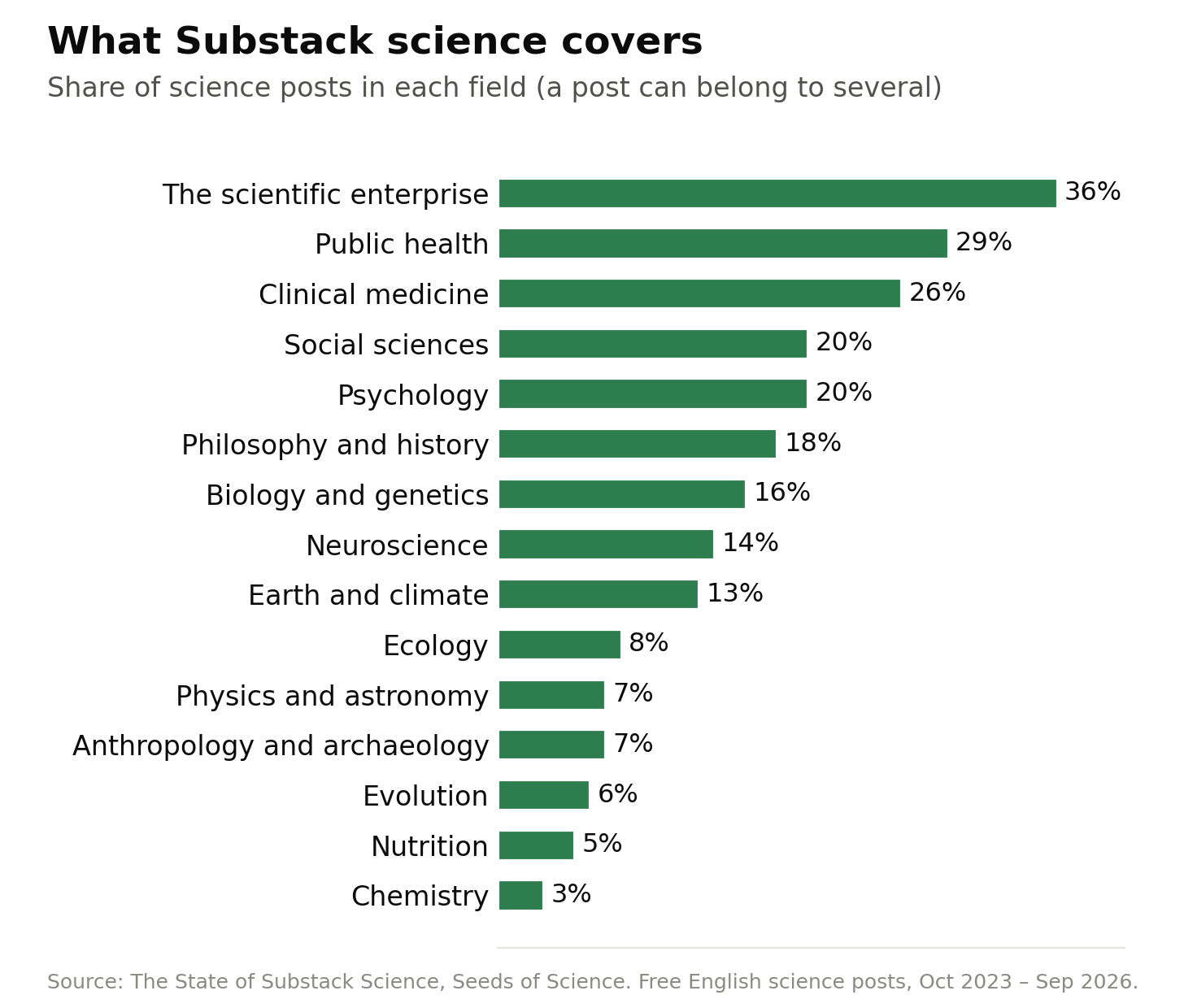
Fields overlap rather than nest. “Biology and genetics” is mostly molecular and cell biology, microbiology, immunology, genetics and synthetic biology, but 23% of its posts are also tagged ecology, 19% evolution and 15% neuroscience.
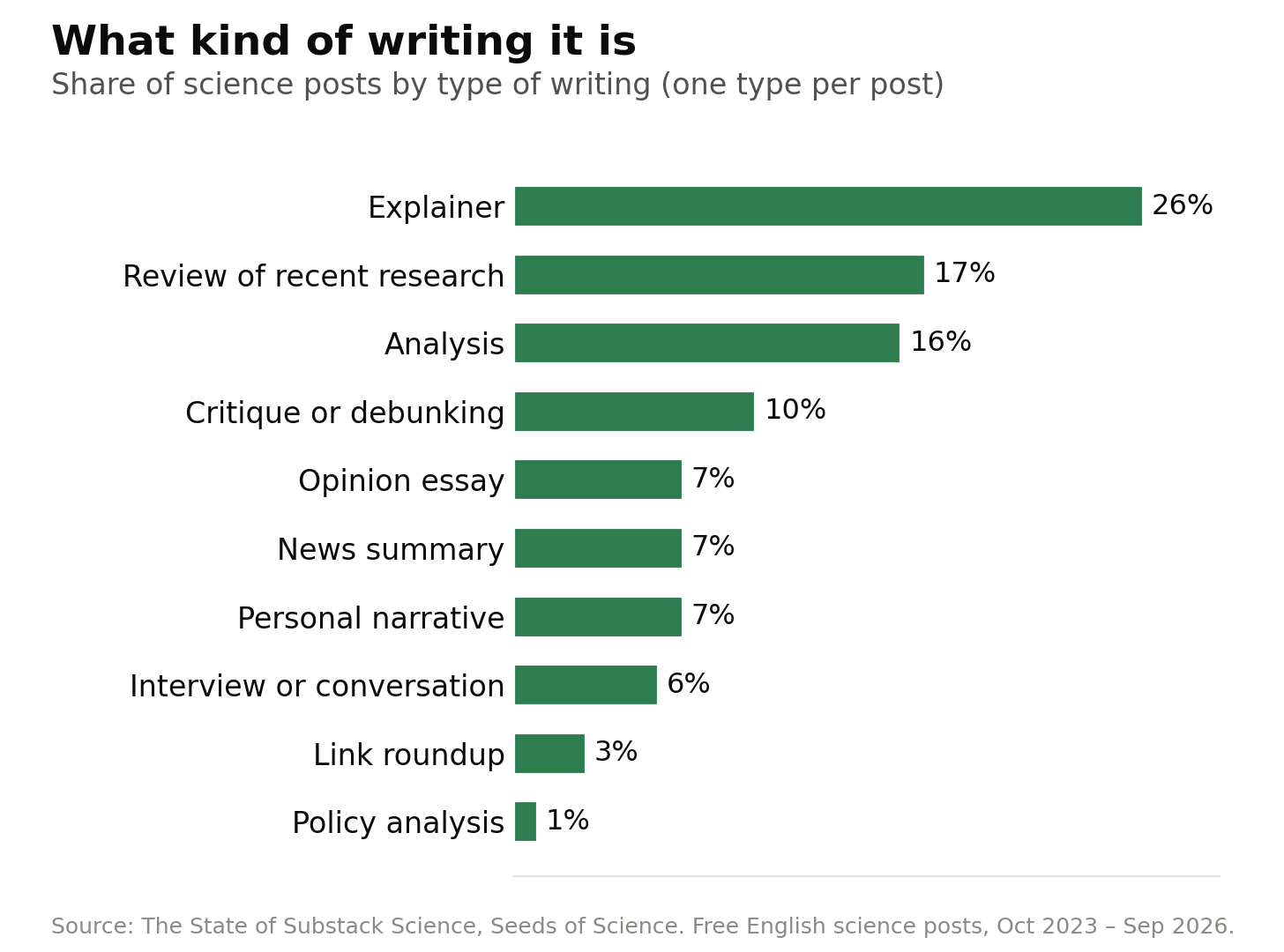
What they are like: The most common kinds of post are explainers (26%), reviews of recent research (17%) and analysis pieces, in which the writer works through a question themselves (16%). 20% include at least some of the writer’s own data or analysis; 11% substantively involve AI (as defined above); 4% are fringe (rejecting a strong scientific consensus). In tone, 30% are concerned, 28% optimistic, 16% critical, 14% mixed and 12% neutral. The typical (median) post is 1,440 words long, up from 1,280 in Year 1, and 30% run past 2,000 words. 5% are podcasts.
Main findings
What it is and who writes it
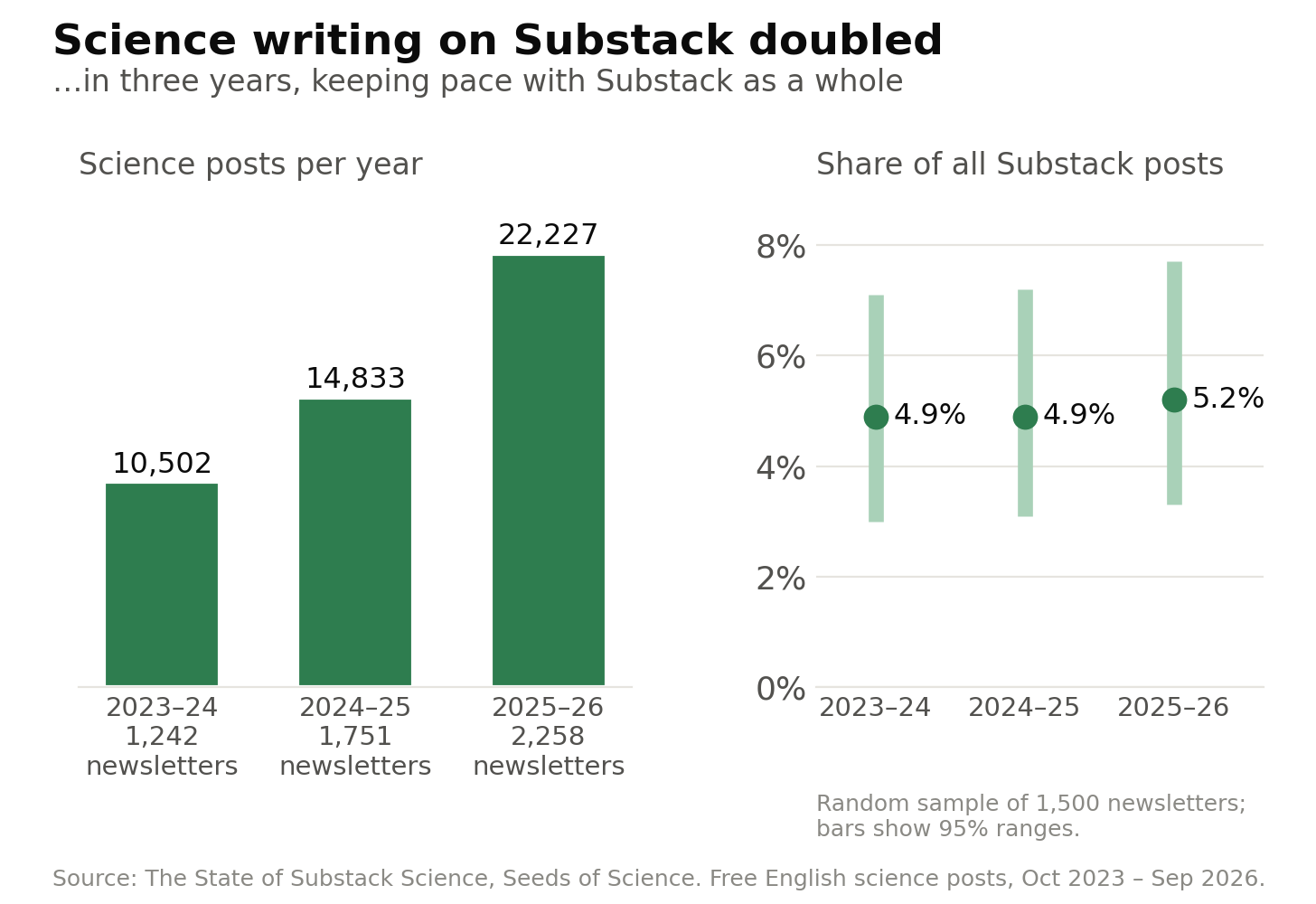
1. About 5% of Substack is science, and it is growing in step with the platform. Science posts doubled in three years, from 10,502 in Year 1 to 22,227 in Year 3, and the number of newsletters writing them nearly doubled (1,242 → 2,258). In a separate random sample of 1,500 Substack newsletters, science held at about 5% of all English posts in each of the three years.
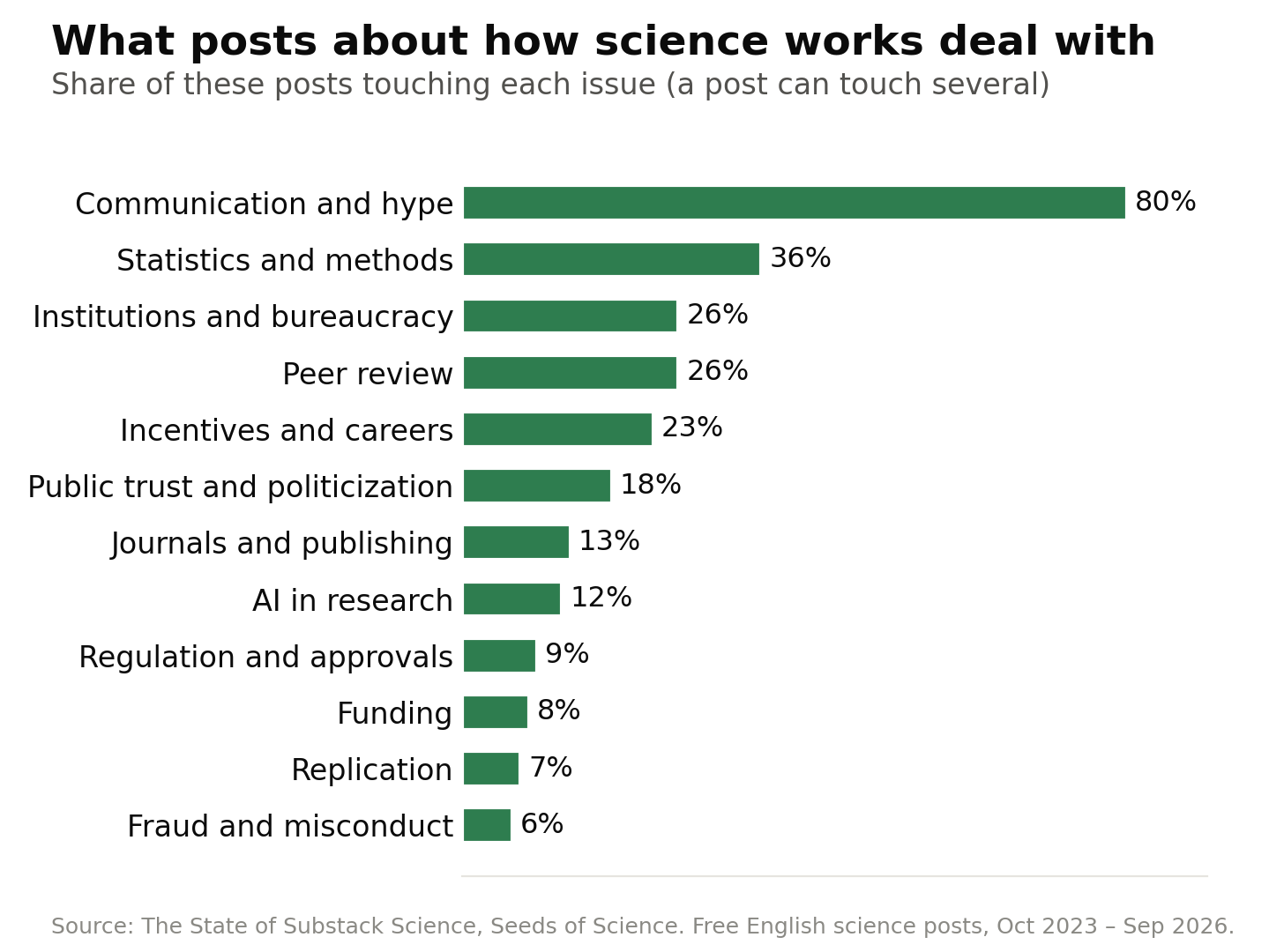
2. The most written-about field is science itself. Of the 15 fields I classified, the biggest is the scientific enterprise: 36% of science posts are mainly about how science is done, funded, published, communicated and trusted. Within it, 80% of posts deal with how science is communicated (how findings are explained to the public, covered by the media, hyped or misrepresented). Two other strands run through it: metascience (statistics and methods, peer review, replication, fraud, journals, open science; 53% of these posts), and the institutions science runs on (universities, agencies, funding, careers, regulation; 45%). Critique is its dominant genre: critique-and-debunk posts (taking apart a specific study, claim or public figure) are the most common type (22%), ahead of analysis pieces (18%) and explainers (17%).
3. Health is the most common subject matter. Public health or clinical medicine (two of the study’s fields) appears in 40% of science posts, and a third of these are also about the scientific enterprise: vaccine trust, drug approvals, critiques of medical studies. Within public health, infectious disease is still the largest subfield but has shrunk (29% → 21% of public-health posts), while health systems and policy (insurance, hospitals, drug pricing, government health agencies) grew fastest (13% → 19%). The most-discussed living person in all of Substack science is Robert F. Kennedy Jr. (536 mentions; 45% of them criticize his conduct), ahead of Einstein and Darwin.
4. Writers with scientific or medical training write about 40% of it. Judging from each newsletter’s description, writers with scientific or medical training (a PhD, MD, research post or professorship, for example) wrote 38% of science posts in Year 1 and 42% in Year 3. By primary role, the biggest groups are independent commentators (essayists, coaches, enthusiasts; 35% of posts), independent researchers (people doing their own research outside a university, company or clinic; 16%), academics (13%), clinicians (13%), organizations (9%) and journalists (9%).
5. Newcomers write most of it; incumbents hold the top. Newsletters that started after October 2023 wrote 15% of science posts in Year 1, 37% in Year 2 and 53% in Year 3. At the top, little changes: the same six newsletters have led Substack’s Science leaderboard since 2022–23 (Your Local Epidemiologist, Astral Codex Ten, Razib Khan, Rob Henderson, Sensible Medicine, Ground Truths), and the top has become stickier: of the 2022 top 25, only 8 were still in the top 25 a year later, but in each year since, between 14 and 19 have held their place.
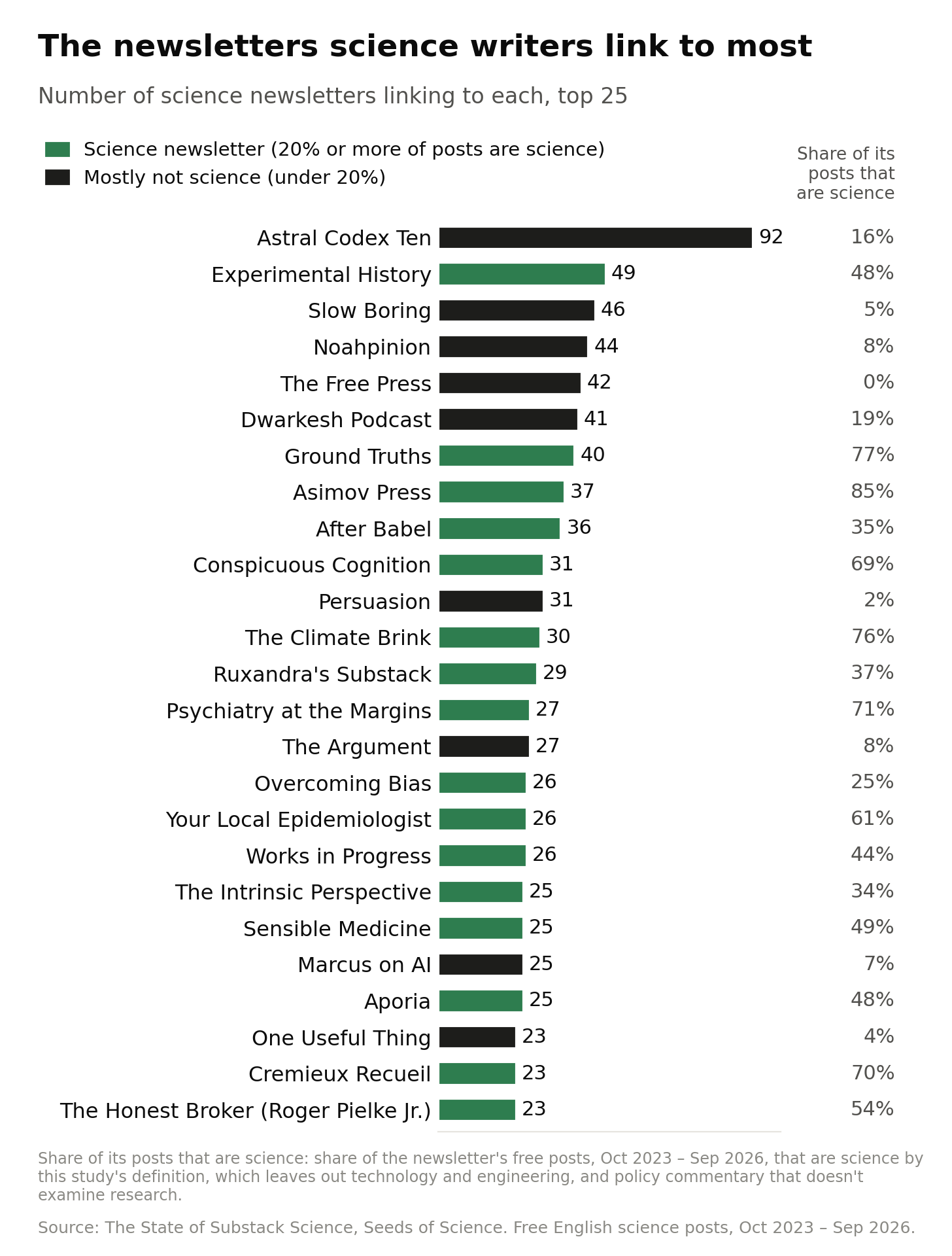
The newsletter science writers link to most is Astral Codex Ten, by a wide margin: 92 science newsletters link to it, almost twice as many as the next, Experimental History (49).
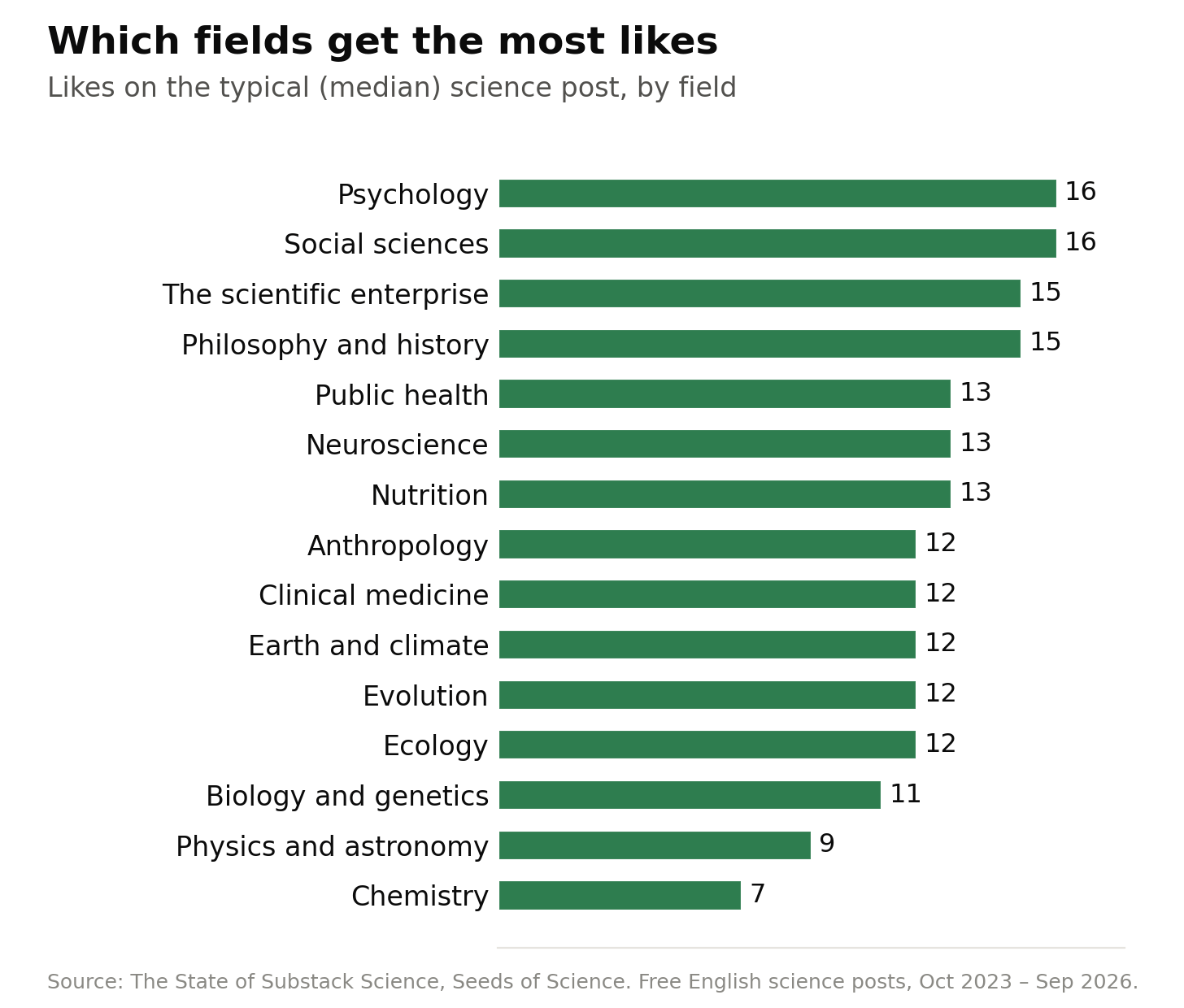
6. The human sciences get the most likes, but form and attitude matter more than field. The typical (median) science post gets 13 likes. By field, the highest medians are psychology (16 likes), social sciences (16) and the scientific enterprise (15); the lowest are chemistry (7), physics and astronomy (9) and biology (11). Much of this variation comes from which newsletters write in each field; comparing posts within the same newsletter, field hardly matters. Form and attitude matter more. 25% of posts do unusually well for their newsletter, getting at least 1.5 times its typical likes; the following percentages are the share of posts in each group that meet this 1.5× threshold. Opinion essays (32%) and critique-and-debunk posts (29%) do best. By tone, critical posts do best (29%), then concerned (26%), optimistic (24%) and mixed (23%), with neutral posts last (20%). Subfields vary more: philosophy of AI (34%), personality psychology (33%), fraud and misconduct (32%) and the neuroscience of consciousness (30%) do best; open science (21%) and forests and land (18%) worst. The most-liked posts of the three years were Uncharted Territories’ ”Why Warm Countries Are Poorer” (25,000 likes), David Oks’s “Why China got rich and India didn’t” (20,000) and Experimental History’s “The Decline of Deviance” (13,000).
Mood
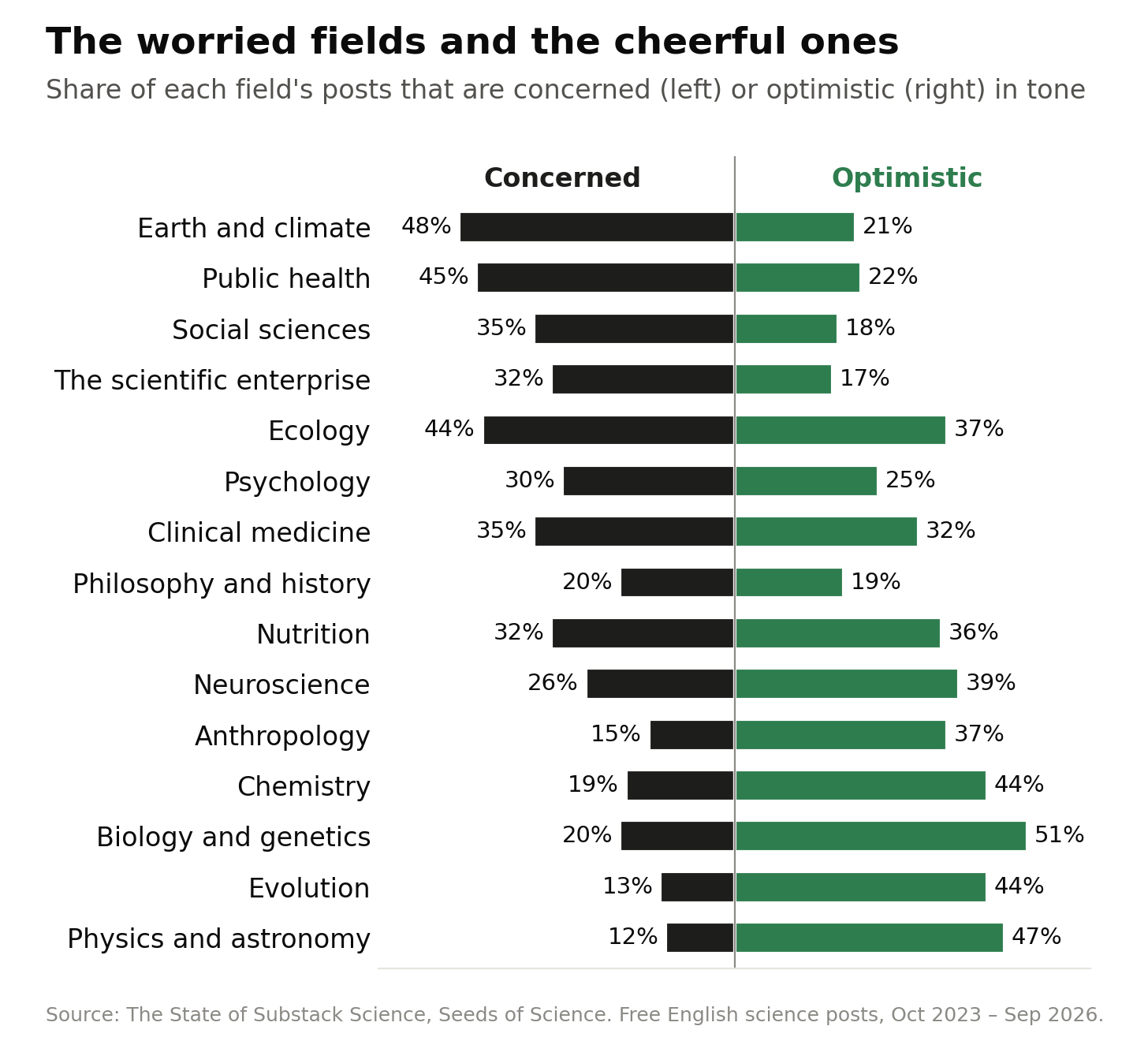
7. The fields split into the worried and the cheerful. An AI classifier gave each post one label for its overall tone toward its main subject: optimistic, concerned (worried about a problem or risk), critical (finding fault with a specific study, claim, person or institution), mixed or neutral. Climate (48% of posts concerned), public health (45%), ecology (44%), clinical medicine and the social sciences (35%) are the worried fields. Biology (51% optimistic), physics and astronomy (47%), evolution (44%) and chemistry (44%) are the cheerful ones: the discovery fields, where a post is usually about something found. The scientific enterprise is the most critical field: 29% of its posts are critical, nearly twice the average (16%).
Who and what they discuss
8. The most-discussed researchers, and the most argued-over. The dead dominate: the most-discussed scientists are Einstein (404 mentions), Darwin (317), Newton (245), Aristotle (243) and Feynman (174). Among contemporary researchers the leaders are Daniel Kahneman (141 newsletters), Jonathan Haidt (112), Richard Dawkins (81), Daniel Dennett (71), Steven Pinker (67) and David Chalmers (65). Researchers are mostly cited rather than attacked: only 9% of mentions critique their work or conduct. The most argued-over are the influenza researchers Ron Fouchier and Yoshihiro Kawaoka (69% of mentions critique their gain-of-function work, almost all from a handful of biosecurity newsletters), the behavioral economist Dan Ariely (44%, after the fraud allegations against him), the climate economist William Nordhaus (38%) and the climate scientist Michael Mann (37%). The most uniformly endorsed are the philosopher and cognitive scientist Andy Clark (95% of mentions favorable), the cognitive psychologist Daniel Willingham (95%), the psychologist Gerd Gigerenzer (91%), the educational psychologist John Sweller (88%), Katalin Karikó (86%) and Michael Levin (84%). A few names rose far faster than science writing as a whole, each from a handful of newsletters: Demis Hassabis (3 → 31 newsletters, after his 2024 Nobel Prize for AlphaFold), Jay Bhattacharya (3 → 29, after becoming director of the US National Institutes of Health), Joel Mokyr (3 → 23, after his 2025 Nobel Prize in economics), Terence Tao (2 → 22, as AI began to do serious mathematics), and the neuroscientists Karl Friston (6 → 32) and Anil Seth (7 → 26) with the growing interest in consciousness.
9. The books and papers they discuss. The most-discussed books are mostly older classics: Thinking, Fast and Slow (78 newsletters), On the Origin of Species (61) and The Structure of Scientific Revolutions (54). The only recent book near the top is The Anxious Generation (52). The most-linked paper is MIT’s “Your Brain on ChatGPT”, a 2025 preprint on the cognitive cost of writing with AIz (37 newsletters), followed by Ioannidis’s “Why Most Published Research Findings Are False” (2005; 28), “Attention Is All You Need”, the influential 2017 paper that paved the way for today’s language models (26), AlphaFold 2 (25), and three health studies from the period: the Swedish sibling study finding no link between acetaminophen (paracetamol) in pregnancy and autism (21), microplastics in arterial plaque (20) and the Welsh natural experiment linking shingles vaccination to less dementia (20).
10. The questions they keep asking. From every post I extracted the open questions it raises, the unknowns and debates the writer points to (118,000 in all), and grouped near-identical wordings. The most-asked single question, raised by 85 newsletters, is whether AI could be conscious and how we would know. The largest question topics are how AI is changing science (279 newsletters), how children learn (224, driven by a tight community of science-of-learning newsletters), peer review and publishing (222) and whether AI models really reason and understand (195). The most-asked questions in each field (with the number of newsletters asking within that field):
Biology: do findings in animals translate to humans? (16; also among the top questions in neuroscience and nutrition, making it the most cross-cutting question in the data); will H5N1 evolve to spread between people? (15); can personalized mRNA cancer vaccines deliver? (13)
Psychology: can behavioral interventions produce lasting behavior change? (27); why are reported mental-health problems rising among young people? (17); what role does prior knowledge play in reading and learning? (12)
Social sciences: what explains falling birth rates (21), and can policy reverse them? (16); how can cause and effect be identified in observational data? (20); what kinds of communication counter misinformation? (10)
Neuroscience: can consciousness be explained by physical brain processes? (24); how do psychedelics produce their therapeutic effects? (17)
The scientific enterprise: how can research misconduct and fraud be prevented? (32); how can peer review be fixed? (28); how common is data fabrication in published research? (22)
Clinical medicine: why do health systems fail to adopt evidence-based practice? (14); can biomarkers tell aggressive prostate cancers from slow-growing ones? (11); do GLP-1 drugs reduce heart attacks and strokes independently of weight loss? (9)
Public health: why do misconceptions persist after they have been refuted? (12); how much of the rise in autism reflects changes in diagnosis rather than real increases? (9); why is vaccination coverage falling in some regions? (7)
Nutrition: what are the long-term effects of GLP-1 drugs? (31); how do genetic differences shape how people metabolize food and their risk of disease? (26); what are the long-term health effects of microplastics in food? (21)
Earth and climate: will the Atlantic overturning circulation (AMOC) collapse this century? (24); can renewable energy meet global demand and decarbonization goals? (21); can stratospheric aerosol injection be deployed safely at scale? (14)
Ecology: can restoration reverse ecosystem degradation at scale? (18); can wildlife populations recover with habitat protection? (15); how will thawing permafrost affect the Arctic? (11)
Evolution: what selective pressures shaped human traits? (15); did climate or human hunting kill off the megafauna? (14); how did early human populations migrate and mix? (9)
Physics and astronomy: what is dark matter? (19); will quantum computers beat classical computers in practice? (13); what physics lies beyond the Standard Model? (11)
Chemistry: can carbon capture scale fast enough to meet climate goals? (11); can new battery chemistries replace lithium-ion? (7); did the sugars of early life come from space? (6)
Anthropology and archaeology: what caused particular societies to collapse or be abandoned? (8); how do societies hold together without central authority? (8); what caused the Bronze Age collapse? (5)
AI, asked across fields: could AI be conscious, and how would we know? (85), what long-term AI use does to the brain (25), whether AI can do science on its own, reasoning and generating hypotheses (22), and whether AI can reason morally (20)
Two themes cut across fields: whether correlations in observational studies reflect real causes (asked in the social sciences, public health, nutrition and philosophy), and the health effects of microplastics (ecology, chemistry and nutrition). Over the three years the questions moved from the pandemic to AI. Topics on how AI is changing science, AI alignment and safety, AI consciousness, and AI and jobs more than doubled; long COVID, H5N1, psychedelic therapies and the origin of SARS-CoV-2 halved. The fastest-rising specific questions of Year 3 were about AI-enabled biosecurity, whether El Niño returns strongly in 2026, whether quantum computers will work in practice, and how to catch AI-generated scientific fraud.
11. Fringe is small and health-centered. 4% of science posts reject a strong scientific consensus. Nearly half touch public health (48%) or clinical medicine (42%): COVID vaccines, excess mortality, seed oils, fluoride, ivermectin, autism, low-dose radiation. Outside health, fringe posts mostly dispute climate science, make hereditarian claims about intelligence, challenge relativity or mainstream cosmology, or argue for the paranormal. Fringe posts are angrier (36% critical and 35% concerned, against 16% and 30% overall). In health-adjacent biology they are popular: 7 of the 20 most-liked biology newsletters have at least a quarter of their biology posts tagged fringe.
Notable trends
What changed from Year 1 to Year 3
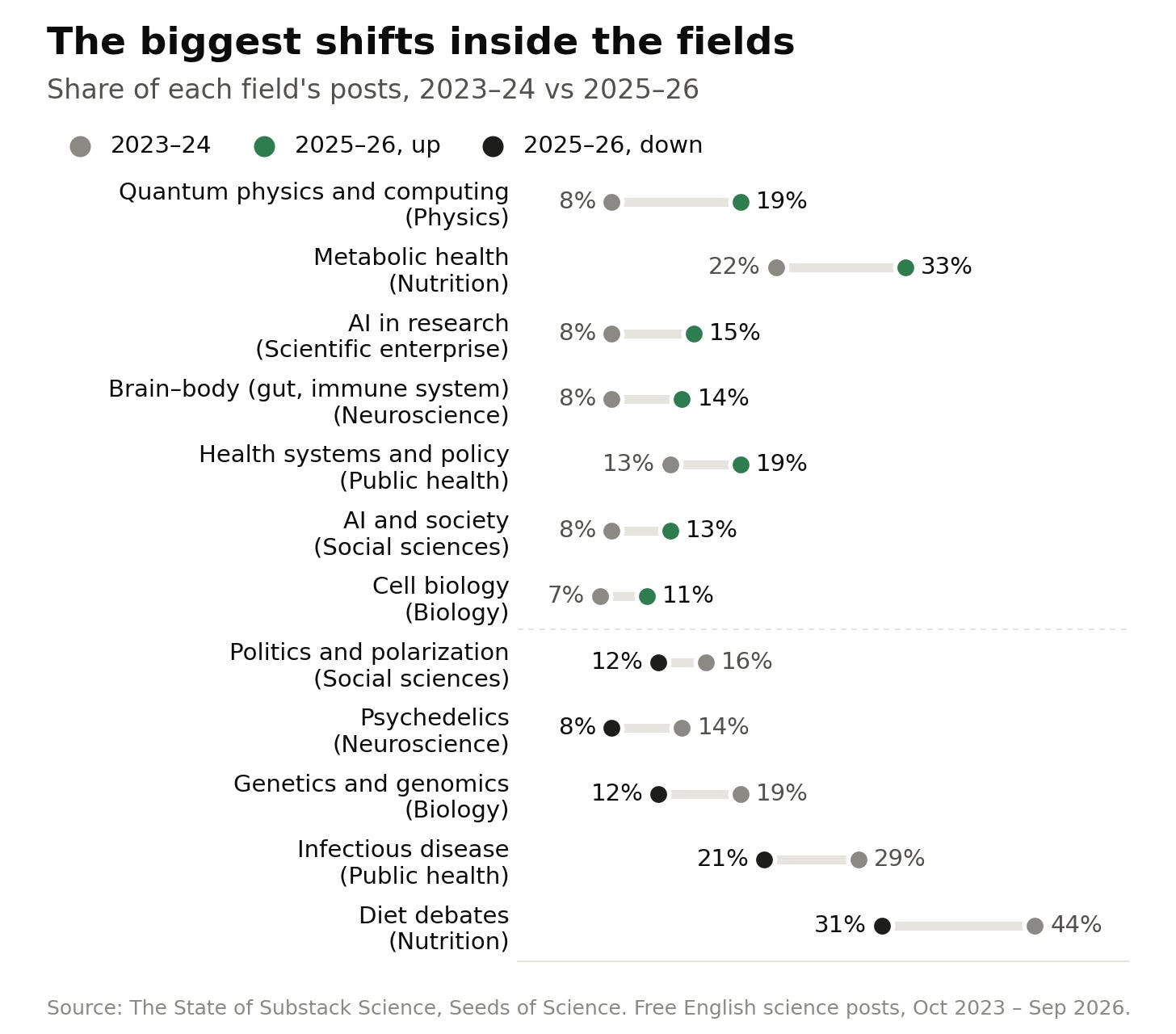
The mix of fields held steady: the six largest fields were the same in Year 1 and Year 3, and no field’s share of science posts moved by more than 4 percentage points. Most of what changed, changed within fields: in the subjects writers chose inside each field, in tone, and above all in AI.
1. AI writing moved from what AI can do to what it does to us, and the mood turned. AI’s share of science posts rose from 7.7% to 13.1%, and the newsletters writing about it tripled (274 → 849). The vocabulary moved from capabilities (GPT-4, prompting, fine-tuning) to consequences (cognitive offloading, reward hacking, sycophancy, alignment faking, agents), and the tone followed. Concern nearly doubled and overtook optimism as the most common tone. The darkening is concentrated where AI is the subject of a post; where AI is a tool in science (protein design, drug discovery, mathematics), posts stayed mostly positive. Writers on climate, medicine, biology and public health stay positive about AI; those writing about the scientific enterprise, philosophy and psychology are the most skeptical. AI posts are also increasingly analysis pieces (14% → 29%) rather than explainers (23% → 15%).
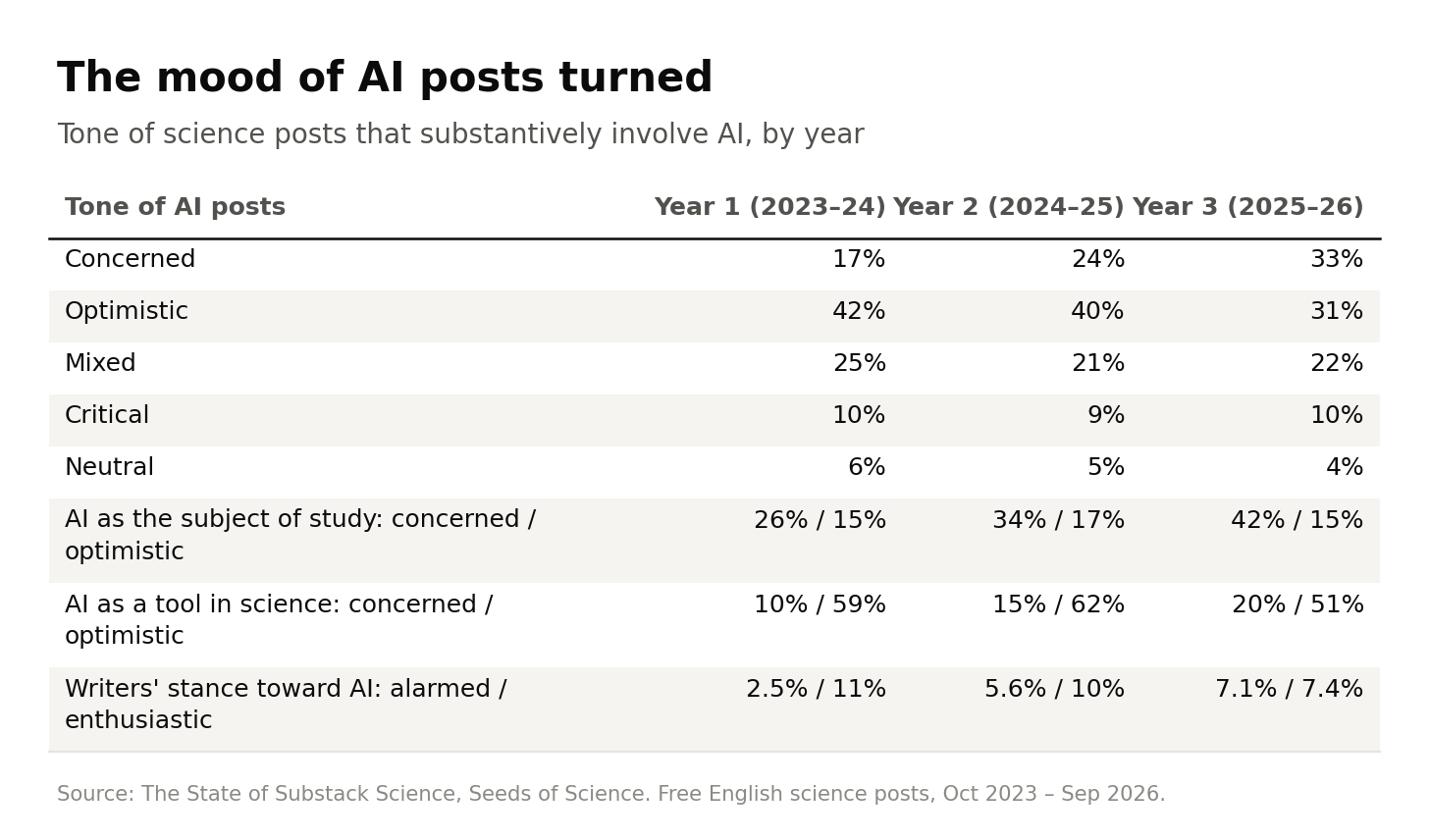
2. AI is now the scientific enterprise’s fastest-growing worry. AI in research more than doubled, from 7% to 15% of posts about the scientific enterprise, and its tone flipped: in Year 1 these posts were 40% optimistic and 19% concerned; by Year 3, 28% and 35%. Posts about both AI and the scientific enterprise grew from 3.9% to 8.5% of all science posts, the fastest-growing intersection in the data.
3. Within the scientific enterprise, the worry moved from metascience to institutions. Metascience, the science of science itself (statistics and methods, peer review, replication, fraud, journals, open science), fell from 58% to 52% of posts about the scientific enterprise, while writing about the institutions science runs on (universities, agencies, funding, careers, regulation) rose from 40% to 49%. Both grew more worried. Metascience posts are mostly critical, finding fault with specific studies, journals and reviews, but they turned from attacking to worrying (critical 44% → 37%, concerned 26% → 34%). Institutional posts are the most concerned, and more so each year (34% → 42%); science policy and regulation posts went from 37% to 49% concerned.
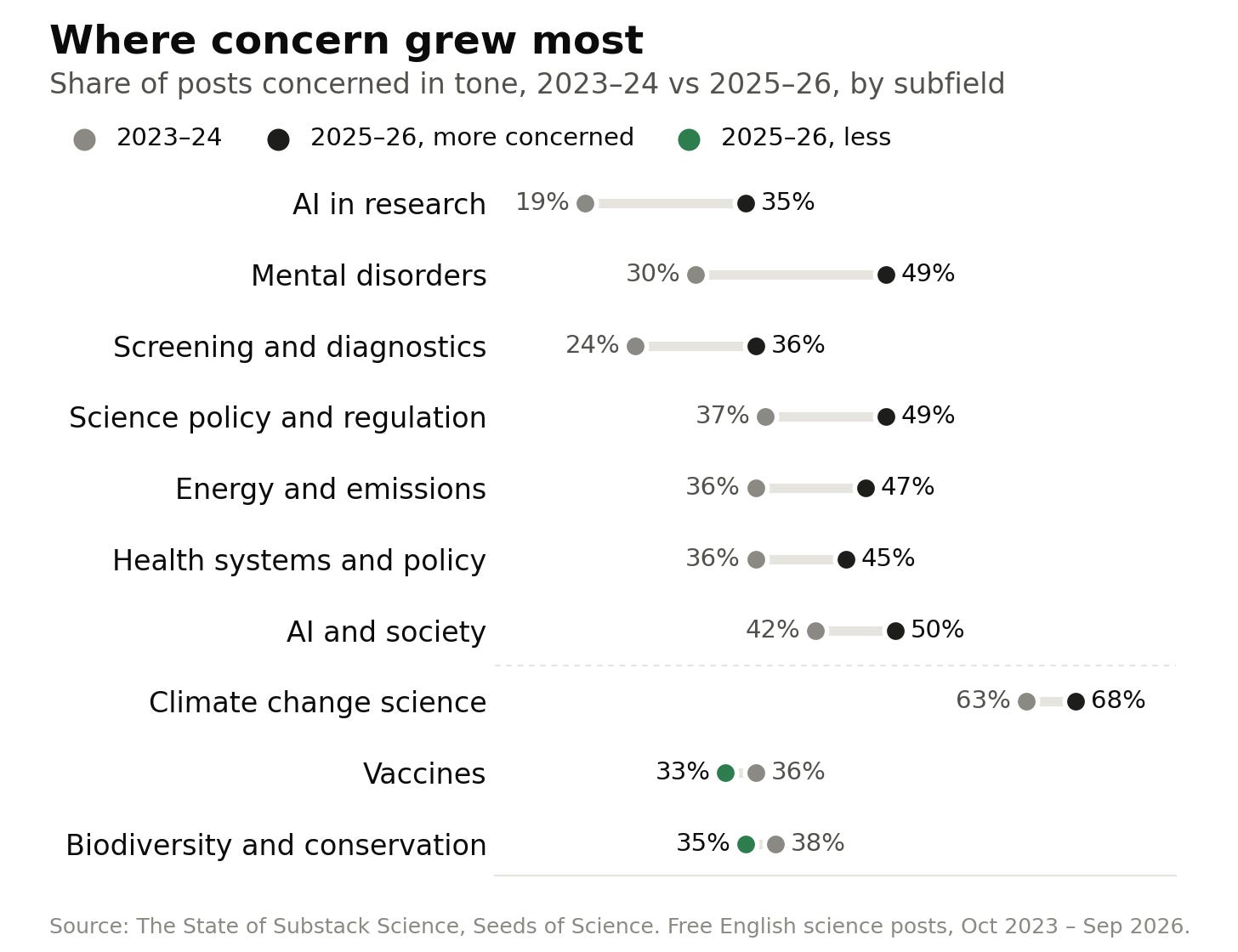
4. The overall tone was largely stable, but concern rose sharply in a few subfields. Across all science posts, concerned posts rose slightly (28% → 32%) and neutral ones fell slightly (15% → 10%); optimism held at 26–28%. Concern grew most in subfields about minds and medical systems: mental disorders (30% → 49% of posts concerned), screening and diagnostics (24% → 36%), health systems and policy (36% → 45%), energy and emissions (36% → 47%) and AI and society (42% → 50%). The rise in screening and diagnostics comes from AI in diagnosis (12% → 31% concerned), consumer tests and wearables (21% → 43%), overdiagnosis and the harms of screening (31% → 46%), and the accuracy of tests and the evidence behind them (27% → 40%). Concern did not grow in the discovery fields: biology stayed 48–50% optimistic in all three years, and physics settled at 47% optimistic after a Year 2 spike in quantum computing (61%).
5. The pandemic is draining out. Infectious disease fell from 29% to 21% of public-health posts and from 11% to 8% of clinical posts. Excess mortality, H5N1, long COVID, wastewater surveillance and mRNA vaccines are the fastest-fading terms. What replaced them: health systems and policy (insurance, hospitals, drug pricing, health agencies: 13% → 19% of public health), chronic disease (4% → 7%), cancer (6% → 9% of clinical posts) and neurology and dementia (4% → 7%).
6. Diet debates gave way to metabolic health. Within nutrition, arguments over fats, seed oils, carbs and meat fell from 44% to 31% of posts, while metabolic health rose from 22% to 33%. These posts are about how the body handles energy: insulin resistance and blood sugar, mitochondria, muscle and exercise, cholesterol, and fasting and ketosis (the fastest-growing theme). GLP-1 drugs stayed among the most-used terms in all three years.
7. Biology shifted toward the cell and away from the gene. Molecular and cell biology rose from 6.7% to 10.6% of biology posts, spread across 177 newsletters and much of it about mitochondria and metabolism; genetics and genomics fell from 19% to 12% as last year’s genetics-heavy newsletters slowed. Rising terms: mitophagy, personalized cancer vaccines, synthetic cells, thymic involution; fading: IVF, embryo testing, stem cells.
8. Neuroscience turned to the body, physics went quantum, climate turned to extreme weather. Within neuroscience, writing grew on how the brain interacts with the rest of the body (one subfield covering the gut–brain axis, the immune system and inflammation: 8% → 14% of neuroscience posts) and on sleep (3.5% → 6%), while psychedelics nearly halved (14% → 8%). In physics, quantum physics and computing went from 8% to 19% of posts. In earth and climate, energy and emissions shrank (24% → 17% of posts) and extreme weather grew (16% → 21%).
Methods
Constraints
Polite and identified. My crawler named itself (Seeds of Science, with a contact email), made fewer than one request per second, backed off whenever asked, and followed every site’s robots.txt. Seven sites refused it; I skipped them. Substack never blocked or throttled it.
Public content only. I read only free posts. For paid posts I recorded only what’s public (title, date, likes, comments), never the text. No logins, no subscriber data, no personal information.
Writers’ wishes respected. Newsletters that ask AI crawlers to stay away are kept in the counts but flagged; their text was used only to classify posts, never to train anything. Any writer can ask to be removed (info@theseedsofscience.org).
“Science” is a judgment call. I wrote explicit rules and tested them against 207 hand-labeled posts.
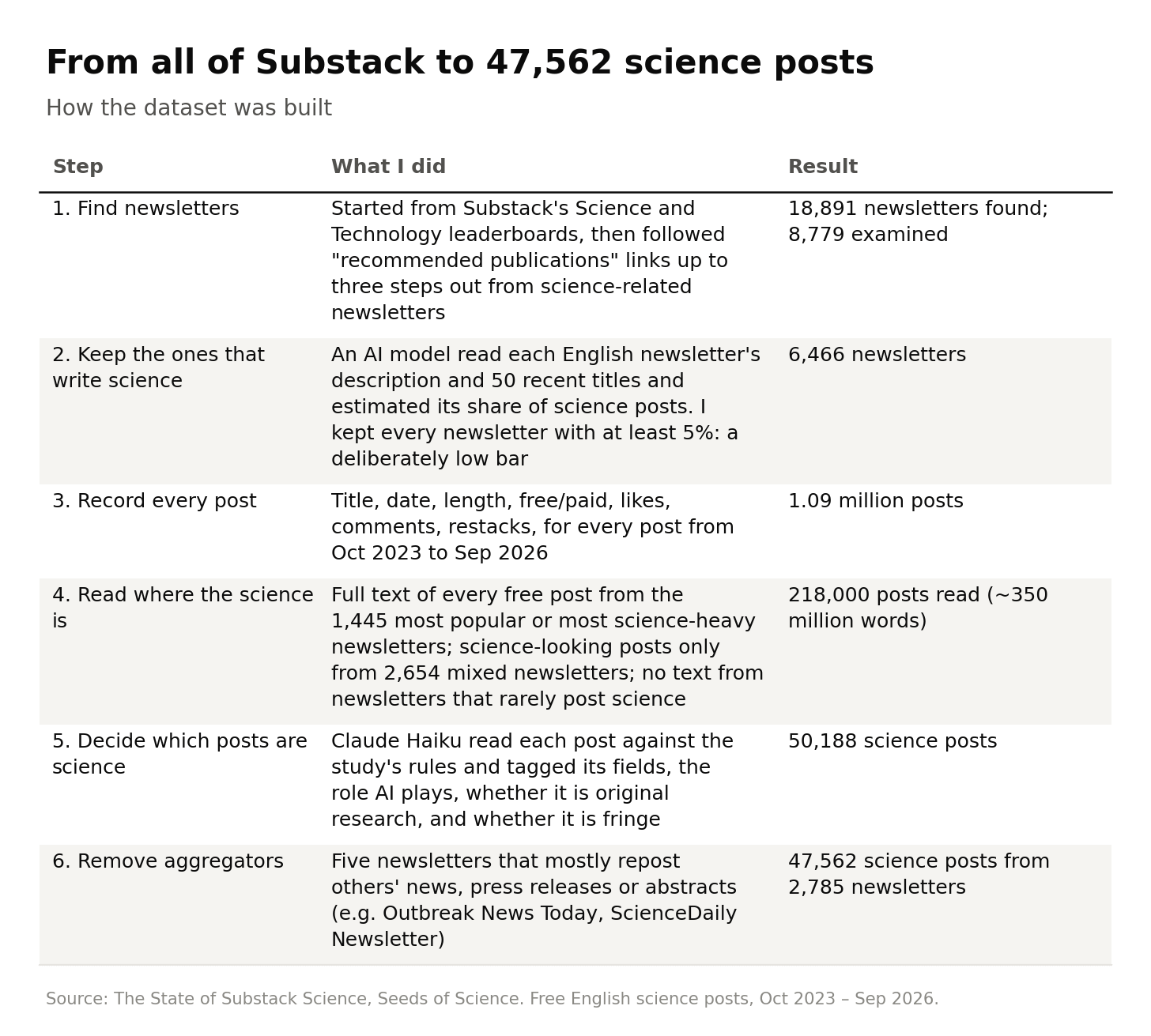
From all of Substack to 47,562 science posts
What counts as science
In: natural sciences; social sciences; medical and health research; metascience (research about research); philosophy and history of science. Out: wellness and diet advice, policy commentary, pure math and computer science, engineering and product writing, and AI industry news. Posts about AI are in scope when AI is studied scientifically, used as a tool in science, or its effects on society are studied empirically. When I report AI’s share of science posts I use one slightly broader definition throughout (see Appendix A).
A set of 207 posts was labeled by hand, with the 50 hardest cases decided one by one, and those decisions became the classifier’s rules. The classifier agreed with the hand labels on 86% of posts, and its mistakes ran both ways (posts wrongly counted in and wrongly left out), so shares and trends are reliable even though any single label may be wrong.
The years
The three “years” run October to September: Year 1 = Oct 2023–Sep 2024, Year 2 = Oct 2024–Sep 2025, Year 3 = Oct 2025–Sep 2026. An arrow (12% → 14%) always means Year 1 → Year 3.
Limitations, plainly
This is a popularity-based sample, not a complete census. I found the 6,466 newsletters by starting from Substack’s science leaderboards and following recommendations outward. Isolated newsletters nobody recommends are under-represented, and so are newsletters that went quiet before 2026, which inflates growth and the newcomer share somewhat.
Free posts only. Writers who paywall most of their work are under-represented in everything based on post text.
Classification is about 86% accurate per post. A title screen used to save money on mostly-non-science newsletters missed an estimated 2–3% of science posts.
Borderline posts. Posts that use research mainly to support advice, opinion or a personal argument were not counted as science. This affects some fields far more than others: such exclusions are common in nutrition, psychology and clinical medicine, and rare in the physical and life sciences. Shares for those fields describe research-focused writing, not all writing that draws on them.
English only.
Trend checks. Before reporting any trend I checked whether a single prolific newsletter was driving it; where one was, I say so.
How this report was made. I designed and directed the study. Claude, Anthropic’s AI model, wrote and ran the data-collection and analysis code, classified the posts (using Claude Haiku), and drafted the report. I reviewed and edited every finding and every sentence.
Questions, corrections or opt-outs: any writer who wants their newsletter removed from the data and the report can email info@theseedsofscience.org.
Results
1. The shape of Substack science
How big a slice of Substack is science? Science posts doubled over the three years, but Substack itself grew fast over the same period, so the counts alone don’t tell us whether science is a growing share of Substack. The main sample was found by starting from science, so it can’t answer that. I therefore drew a second sample that does not start from science: 1,500 newsletters picked at random from Common Crawl (a public archive of the web) addresses ending in substack.com, and every English post they published in the three years: 154,847 posts. An AI screen read all their titles, and I then read and fully classified 2,094 of them with the same classifier and rules as the main study, to turn “looks like science” into an estimate of what really is.
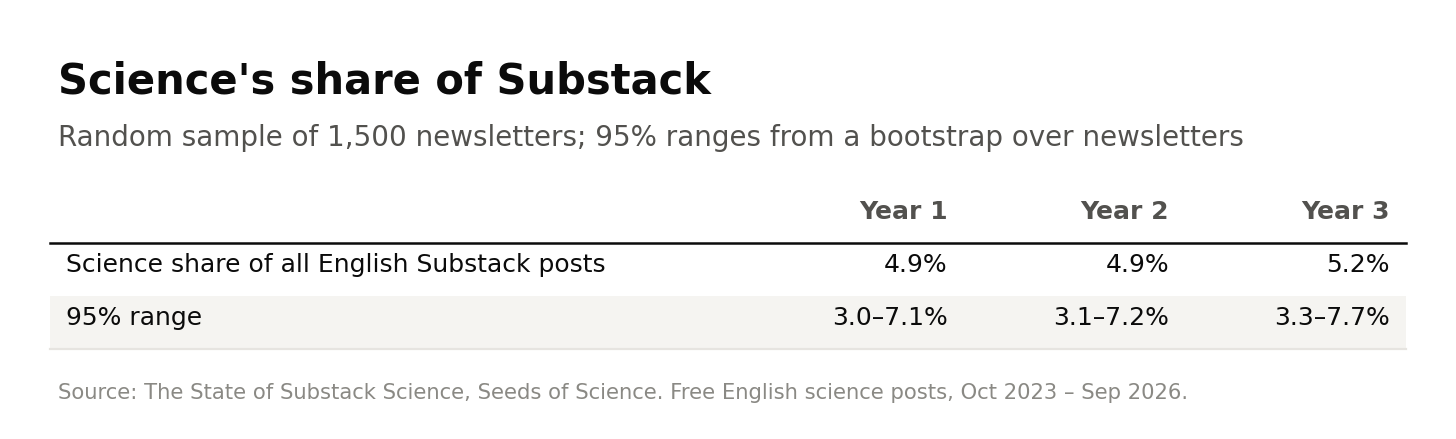
About 5% of Substack posts are science by this study’s definition, and that share held steady or rose slightly. The rise from Year 1 to Year 3 (+0.4 points, or about 7%) is within the margin of error (−0.3 to +1.1 points). So science writing on Substack has grown roughly in step with Substack as a whole. The ranges are wide mainly because science is rare among posts whose titles don’t look like science (9 of the 300 I checked), yet those posts are about 90% of Substack; the year-to-year comparison is more precise than the level, because that uncertainty is shared across years.
Limits of this estimate. Newsletters on their own domains (not ending in substack.com) are missed; Common Crawl favors newsletters that are linked to more; the newsletters were picked from Common Crawl’s 2025–26 captures (I then collected all three years of their posts), so newsletters that stopped before 2025 are under-represented in Year 1 (as in the main study); and the classification check used free posts of at least 150 words.
What it covers. A post can belong to more than one field and fields overlap rather than nest.
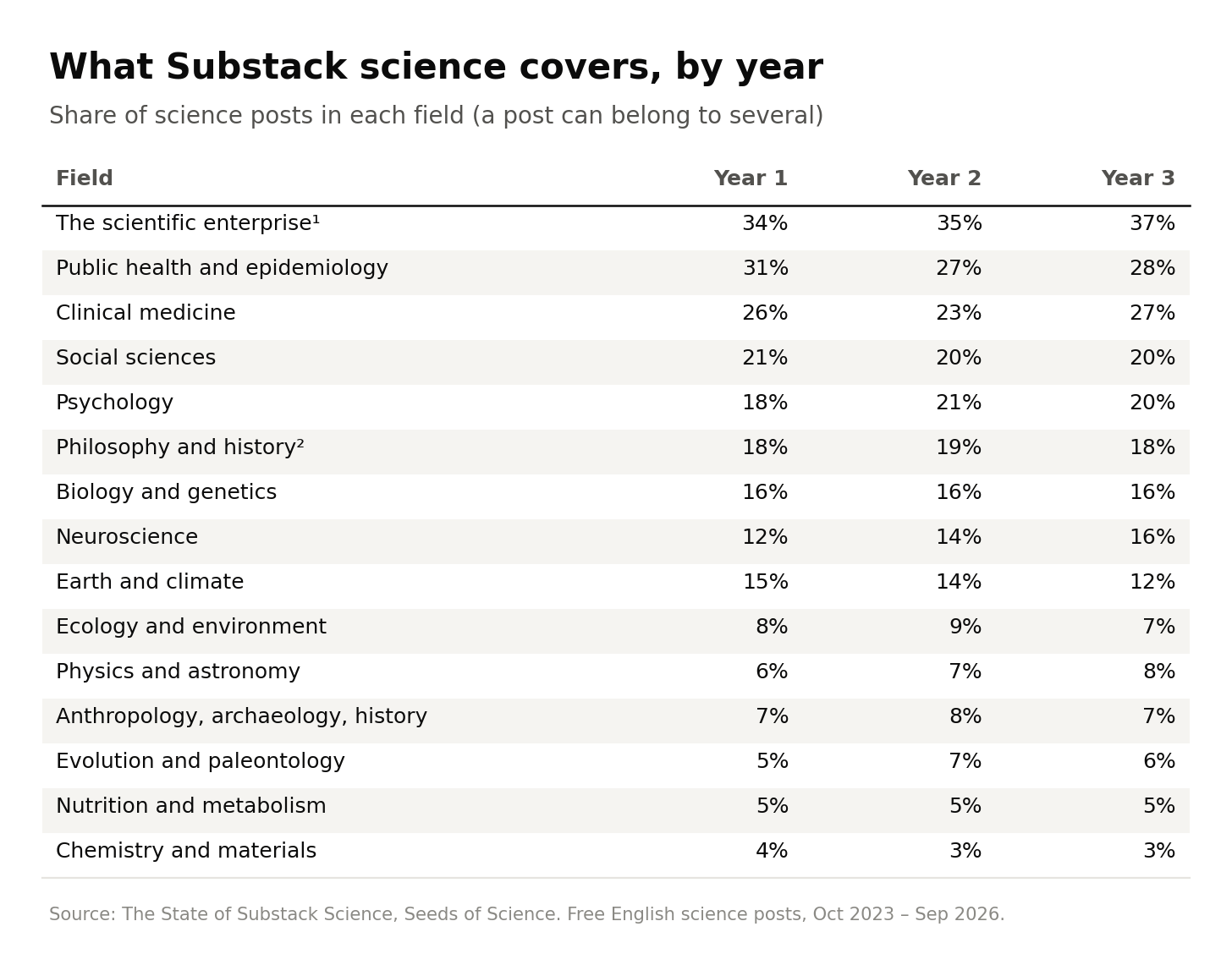
¹ “The scientific enterprise” refers to the theory and practice of scientific research (how it’s done, funded, published, communicated and trusted).
² Philosophy and history covers epistemology and scientific method (39% of its posts), history of science (21%), ethics and values in science (18%), philosophy of mind and consciousness (11%), and the philosophy of biology, AI and physics (3–4% each).
What gets liked. The differences in likes between fields largely reflect which newsletters write in each field: big newsletters lean toward the human sciences. To separate the post from the newsletter, I compared each post with its own newsletter’s typical (median) likes, for the 41,307 posts from newsletters with at least 8 science posts, and counted how often a post did unusually well (at least 1.5 times its newsletter’s typical likes). Judged this way, field hardly matters: 21–27% of posts do unusually well in every field, against 25% overall.
The most-liked posts of the three years: Uncharted Territories’ ”Why Warm Countries Are Poorer” (25,000 likes), David Oks’s “Why China got rich and India didn’t” (20,000), The Forbidden Files’ ”Game Theory Will Change Your Life” (19,000), Tim Seyrek’s “Does Language Shape Thought?” (15,000), The Noösphere’s “There’s a Reason Women Aren’t Swooning Over AI Like Men Are” (15,000) and Experimental History’s “The Decline of Deviance” (13,000).
20% of posts are original research. That is, they present data or analysis the writer produced and is publishing first on Substack (an analysis of public data, a survey or experiment, a new model, a replication, archival or field work); an academic summarizing their own published paper does not count. In 6% of posts this work is the core of the post (substantial); in 14% it is a smaller part (light), such as a single chart made from public data. By the writer’s main role: independent researchers 30% of their posts, industry scientists 25% (they write only 1% of science posts), academics 24%, and organizations and independent commentators 19% each.
2. Newcomers, the frozen top, and who gets linked
The base is new. Of the 2,785 newsletters that wrote science in the period, 1,371 started in or after October 2023.
The top is old. I rebuilt the history of Substack’s paid Science leaderboard from 16 archived snapshots between January 2022 and September 2026. The same core has held the top spots for more than three years: Your Local Epidemiologist (number one since early 2023), Astral Codex Ten, Razib Khan’s Unsupervised Learning, Rob Henderson’s Newsletter, Sensible Medicine and Ground Truths. And the top has become much stickier. Of each year’s top 25, the number still in the top 25 a year later was 8 from 2022 to 2023, 14 from 2023 to 2024, 19 from 2024 to 2025 and 16 from 2025 to 2026.
The longer view is harsher. Of the January 2022 top 25, only two are in today’s top 25 (Astral Codex Ten and Razib Khan), and about half have disappeared from science writing on Substack altogether.
Who science writers link to. I also counted which newsletters science writers link to (each newsletter counted once per linking newsletter). The most-linked are Astral Codex Ten (92 science newsletters link to it) and Experimental History (49), followed by Slow Boring, Noahpinion, The Free Press, Dwarkesh, Ground Truths, Asimov Press and After Babel. Seven of the 25 most-linked publish little science (under 10% of their free posts): the politics and economics newsletters Slow Boring, Noahpinion, The Free Press, Persuasion and The Argument, and the AI newsletters Marcus on AI and One Useful Thing. The single most-linked post was Experimental History’s “The Rise and Fall of Peer Review”, linked from 11 different newsletters.
Caveat. I found newsletters through leaderboards and recommendations, which favor ones that are active today. Older newsletters that went quiet are under-counted, which pushes the newcomer share up somewhat. The leaderboard history is unaffected, since it comes from archived snapshots.
3. What they talk about
What’s rising, what’s fading. I tracked the key terms each post is about, counting how many different newsletters used each term in Year 1 versus Year 3.
Rising: hantavirus, cognitive reserve, AI consciousness, cardiorespiratory fitness, quantum error correction, reward hacking (AI systems gaming their goals), El Niño, AI agents, mechanistic interpretability, the glymphatic system, sarcopenia, Mendelian randomization.
Fading: excess mortality, H5N1, zoonotic transmission, long COVID, wastewater surveillance, psilocybin, mRNA vaccines. The pandemic vocabulary is draining out of Substack science.
The constants: large language models, randomized controlled trials, GLP-1 drugs and the gut microbiome were the most-used terms across all three years.
Inside the fields. I also gave every post one main subfield within each of its fields; the full breakdown is in the explorer. The shift in nutrition from diet debates to metabolic health holds without each year’s three biggest nutrition newsletters (diet debates 41% → 33%, metabolic health 23% → 31%). Human origins and archaeology rose sharply within anthropology, but mostly because of one prolific newsletter.
The overall tone was largely stable. I gave every post one label for its overall tone toward its main subject.
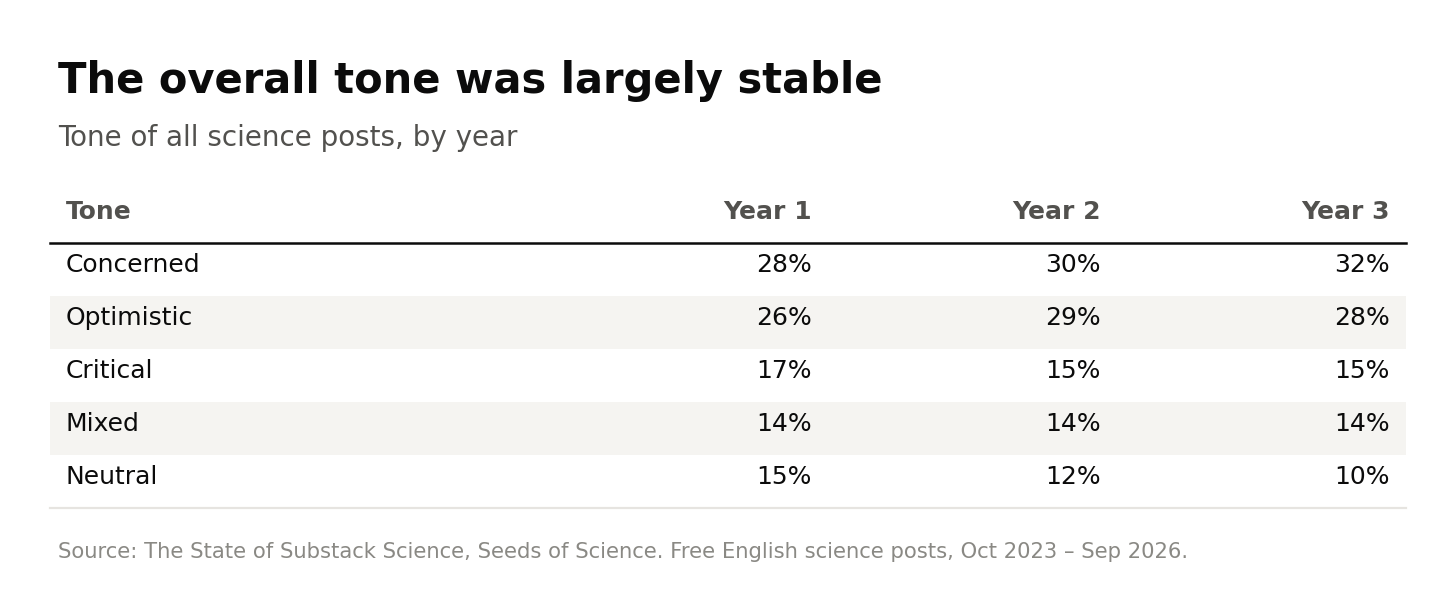
Concerned posts rose slightly and neutral ones fell slightly; optimism held steady.
By field, concern grew fastest in the scientific enterprise, psychology and neuroscience (each up about 7–8 points), and in medicine and the social sciences (about 6); climate rose too (about 4–6 points) from a high base: climate science itself was already 63% concerned in Year 1 (68% in Year 3). These rises hold when each field’s three biggest newsletters are removed.
What they cite. The most-cited journals are Nature, Science, PNAS, The Lancet and NEJM, and the most-linked sources overall are NIH/PubMed and the big publishers. The median cited paper is three years old, but that hides a big difference between fields: climate and physics writers cite last year’s papers (median one year), while psychology, nutrition, anthropology and philosophy writers lean on classics (median six years). Preprints are rare outside AI and physics.
The papers they link to most (counted by the number of newsletters linking to the paper itself; papers cited without a link are missed):
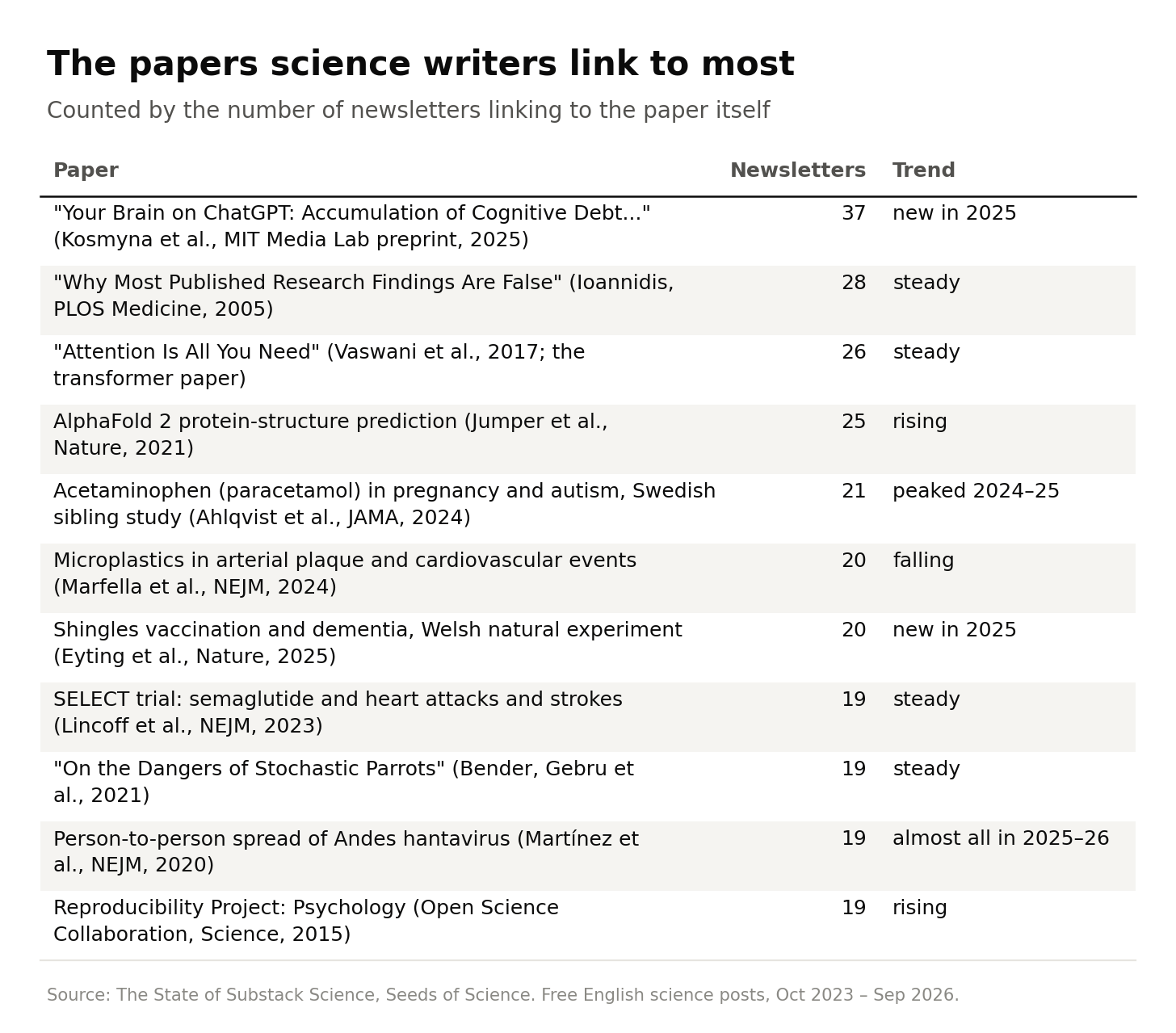
Three kinds of paper dominate: the founding texts of the replication debate (Ioannidis and the Reproducibility Project), landmark AI papers, and recent health studies that made the news. The full list is in the explorer.
The books they discuss. Counting the newsletters that discuss each book:
Thinking, Fast and Slow, Daniel Kahneman (78)
On the Origin of Species, Charles Darwin (61)
The Structure of Scientific Revolutions, Thomas Kuhn (54)
The Anxious Generation, Jonathan Haidt (52)
The Population Bomb, Paul Ehrlich, and Silent Spring, Rachel Carson (31 each)
The Descent of Man, Darwin (29)
The Righteous Mind, Haidt (25)
The Selfish Gene, Richard Dawkins (24)
(Not counted as a book: the psychiatric manual DSM, discussed by 41 newsletters, which would otherwise rank fifth.)
The most-discussed recent book (2023 onwards) after The Anxious Generation is Peter Attia’s Outlive, in 10 newsletters.
4. Who they talk about
Science writers on Substack discussed tens of thousands of people. I counted a person only if at least three different newsletters discussed them substantively, not in passing.
Most discussed: Robert F. Kennedy Jr. (536 mentions), then Albert Einstein (404), Charles Darwin (317), Donald Trump (293), Isaac Newton, Aristotle, Daniel Kahneman, Elon Musk, Jonathan Haidt and Richard Feynman. The dead dominate the scientists: of the top ten, the only working scientist is Haidt.
Most-discussed contemporary researchers (by newsletters discussing them): Daniel Kahneman (141), Jonathan Haidt (112), Richard Dawkins (81), Daniel Dennett (71), Steven Pinker (67), David Chalmers (65), Geoffrey Hinton (62), John Ioannidis (56), Demis Hassabis (50), Eric Topol (49), Nick Bostrom (49), Daron Acemoglu (48), Karl Friston (46), James Hansen (46). Michael Levin is 18th (41 newsletters) and rising. (”Contemporary” includes researchers who died recently, such as Kahneman and Dennett.)
All 305 people discussed 25 or more times, with how often their work is critiqued, endorsed or criticized, are listed in the explorer.
5. Biology
Biology (the biology-and-genetics field together with evolution and paleontology) is 19% of Substack science: 8,920 posts from 1,169 newsletters. It is mostly explained rather than done: explainers (32% of posts) and reviews of recent research (19%) dominate, with a strong strand of personal nature writing (10%).
What biologists write about. Each post was given one main subfield.
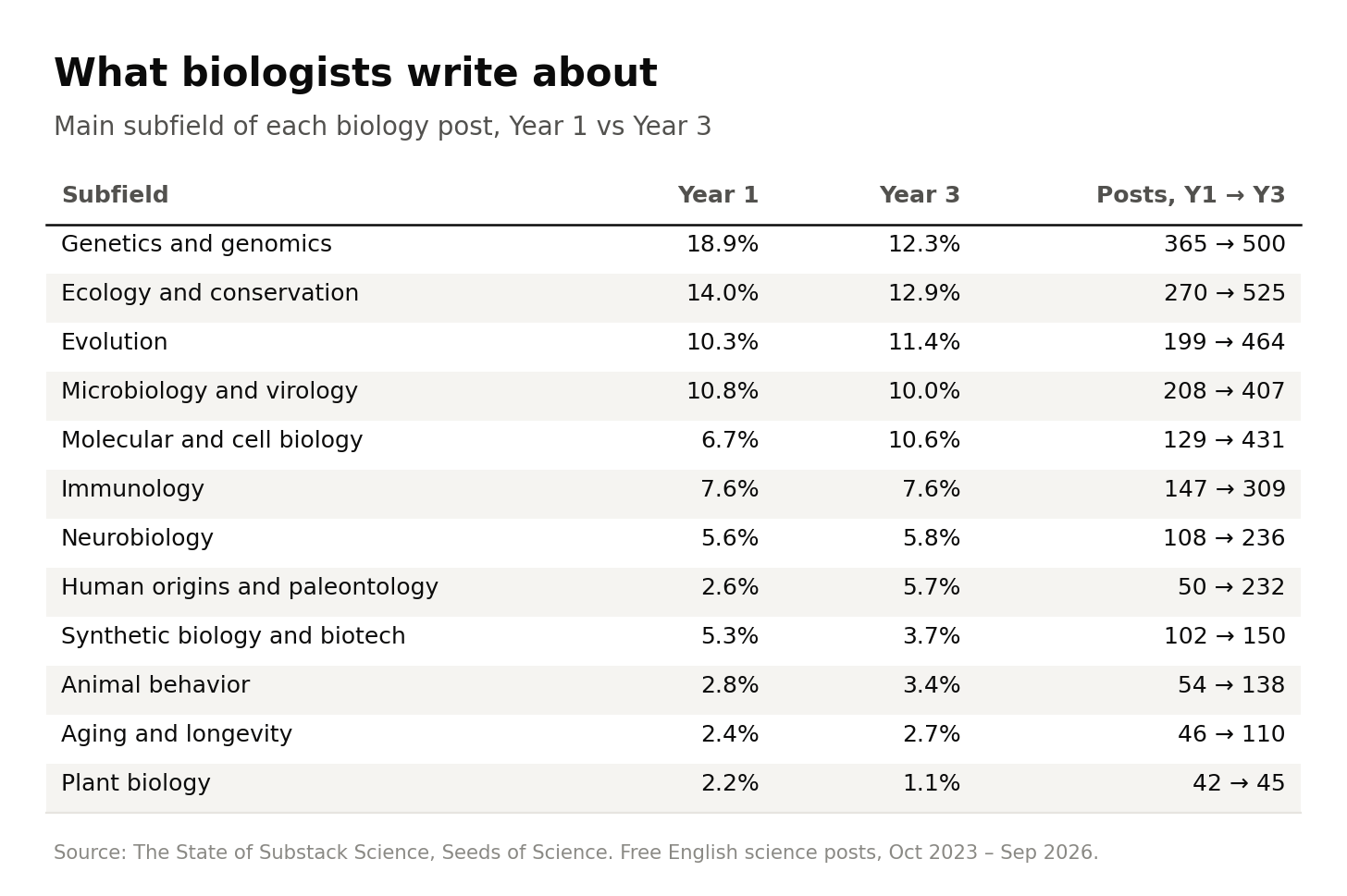
Genetics is losing share, not posts: last year’s genetics-heavy newsletters slowed down, and this year’s genetics writing is spread across 235 newsletters. The rise of human origins is mostly one prolific newsletter; without it, the rise is small (about 2.1% to 2.7%).
Who they read. Biology writers link most to Astral Codex Ten, Asimov Press, The Infinitesimal, Owl Posting and Ground Truths. Their books are Darwin’s: On the Origin of Species (39 biology newsletters) and The Descent of Man (22), then The Selfish Gene (14).
Who they discuss. The most-discussed contemporary biologists are Richard Dawkins (60 newsletters), Michael Levin (36; none of his 73 mentions was classed as critical), Jane Goodall, George Church, Robert Sapolsky, Joseph Henrich and Frans de Waal.
6. The questions Substack science keeps asking
Most science posts leave something unresolved. From every post I extracted the open questions it raises, whether or not they are phrased with a question mark: the unknowns, debates and “we don’t yet know whether…” that the writer points to (about 2.5 per post, 118,000 in all). Counting questions measures what writers treat as open, which is narrower than what they write about. For example, 85 newsletters raised whether AI could be conscious as an open question, but many more discuss AI consciousness in some way: 684 posts from 268 newsletters link AI and consciousness or sentience in at least one sentence, and 241 posts from 106 newsletters do so repeatedly.
The questions are a long tail. Writers mostly end on specific, local questions rather than the textbook “grand challenges”. Even the most-asked single question is raised by fewer than a hundred newsletters out of 2,785.
But the topics have clear leaders. I grouped questions into 41 recurring topics with transparent keyword rules, and checked samples of each by hand. Because science posts doubled over the period, I show each topic’s rate per 1,000 science posts, so a rising number means the topic grew faster than science writing as a whole.
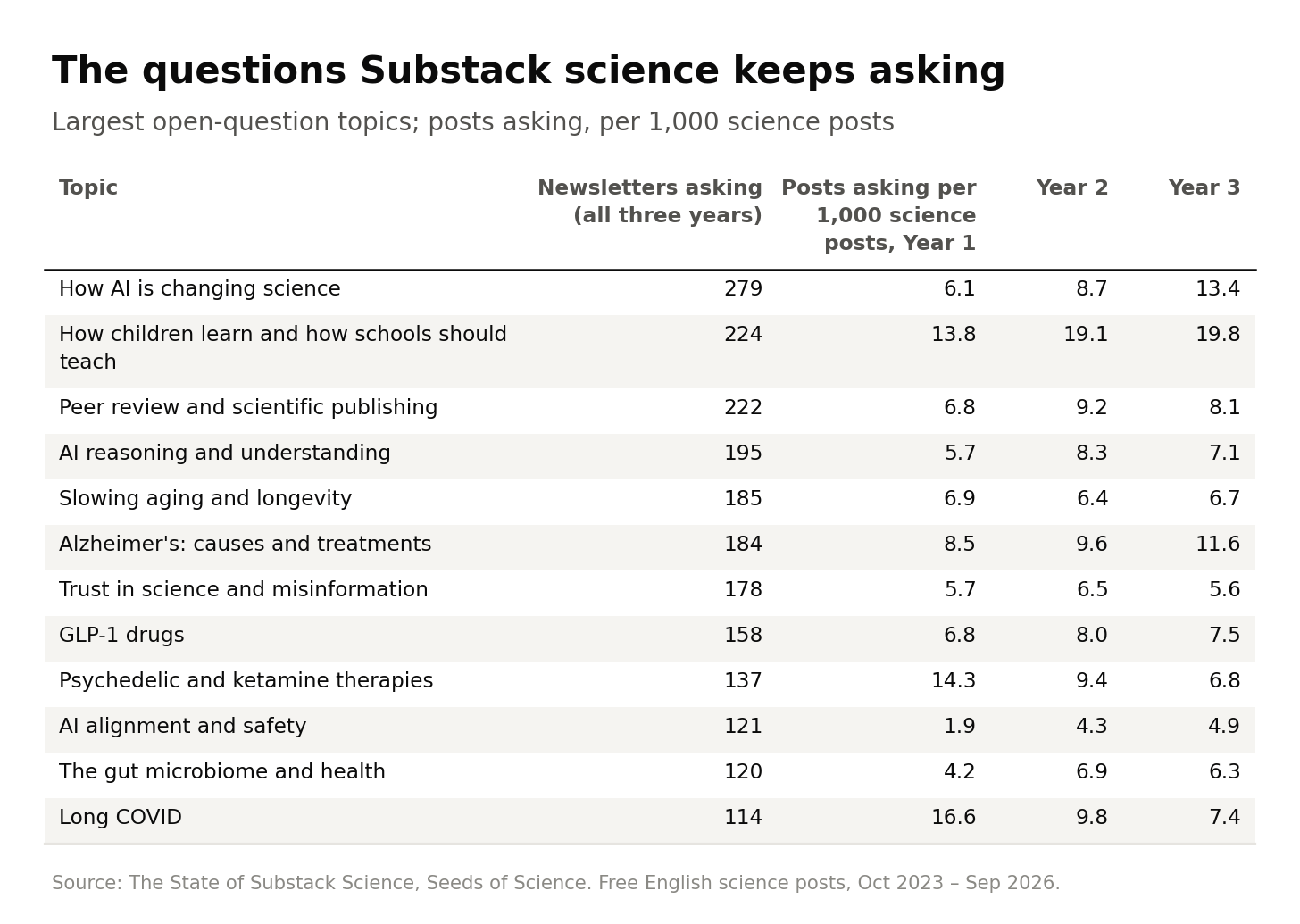
The second-largest topic, how children learn, is driven by a tight community of science-of-learning newsletters (twelve of them ask nearly half of these questions).
Ten questions of the year
The fastest-rising specific questions, with near-duplicate wordings merged:
How can AI-enabled biosecurity monitoring balance safety with open science? (10 newsletters; almost entirely new this year)
Will El Niño return strongly in 2026, and what will it do? (28)
Will quantum computers work in practice? (18)
How do we catch AI-generated scientific fraud? (8)
What is dark matter? (19)
Can personalized mRNA cancer vaccines deliver? (13)
Can AI reason morally, or act as a moral agent? (20)
Will the Atlantic overturning circulation (AMOC) collapse this century? (24)
How can peer review be fixed? (41)
Do findings in animals translate to humans? (61)
And the most-asked question of all three years: Could AI be conscious, and how would we know? Eighty-five newsletters asked it in one form or another, and the number of posts asking it doubled this year.
Ten of the most unusual questions
Most questions are asked once. From the questions raised by only one or two newsletters, here are ten of the most unusual (my selection; wordings lightly standardized):
Do starlings learn to murmurate, or is it innate? (“Pattern song”)
Was the Tully Monster a fish, a worm, or a giant slug with fangs? (“The 350 Million Year Old Shriek”)
Why does the Cherenkov glow in nuclear reactor pools appear that specific shade of blue? (“How We Know the Universe Is Running Away From Us”)
Why do atoms have fuzzy boundaries rather than the neat, crisp edges we draw? (“Feynman Series by a Physicist: What is the one Physics idea we’d want…”)
Why are strings the fundamental objects in string theory, rather than other shapes like frisbees or blobs? (“Why do we need Quantum Gravity?”)
Did Vikings actually navigate with sunstones, or are the saga references myth? (“The Viking sunstone: Did Norse sailors navigate by crystal?”)
Did the Ancestral Puebloans paint the Peñasco Blanco pictograph to record the supernova of 1054? (“Ancestral Puebloans Viewed the Supernova of 1054 CE”)
Can modern violin-makers match the sound of a Stradivarius using treated or high-altitude wood? (“How the Little Ice Age made the Stradivarius”)
Did Robert Falcon Scott’s reliance on canned meat without vitamin C contribute to his failure at the South Pole? (“Obvious in Retrospect”)
Why does the prefix “neuro” make us suspend critical disbelief more than other scientific prefixes? (“Neurobollocks And Psychotherapy”)
The full list of question topics and the most-asked questions in every field are in the explorer.
Appendix A. Definitions
Science post. A post whose main purpose is to examine scientific research or ideas in the natural sciences, social sciences, medical and health research, metascience, or philosophy and history of science. Patient guidance, wellness advice, policy news and AI industry news are out. Classified per post by Claude Haiku against written rules calibrated on 207 hand-labeled posts, including 50 hard cases decided one by one (86% agreement).
Year 1 / 2 / 3. October to September: Oct 2023–Sep 2024, Oct 2024–Sep 2025, Oct 2025–Sep 2026.
Aggregators (excluded). Newsletters whose posts mainly repost or briefly excerpt others’ news, press releases, paper abstracts or templated Q&A: Outbreak News Today, ScienceDaily Newsletter, EarthStuff, The Word Merchant, Rohan’s Bytes (2,529 posts, 5% of the total). Authored digests and roundups are kept. Including the aggregators changes headline figures by under a point.
AI as a substantive subject. The post studies AI scientifically, uses AI as a tool in science, reports social-science research about AI, or argues (without new research) about how AI is changing science or society. Posts that only use AI as an analogy or example are not counted.
Original research. The post presents data or analysis the writer produced, with Substack as the primary venue: substantial if that is the post’s core, light if it is a minor element (for example one chart from public data). Summarizing one’s own journal paper does not count.
Fringe. The post rejects or attacks a strong scientific consensus (for example on vaccine safety, germ theory, climate change or evolution) or promotes pseudoscience. Criticizing a specific study, agency or policy is not by itself fringe. Applied to posts, never to whole newsletters; no fringe newsletter is named in this report.
Science share of all Substack. From a separate random sample: 1,500 newsletters drawn at random from Common Crawl index entries for *.substack.com (2025–26 snapshots), all their English posts from the three years (154,847) title-screened by Claude Haiku, and 2,094 posts (600 screened-in per year, 300 screened-out) read in full and classified with the main study’s classifier. 95% ranges from a bootstrap over newsletters.
Newcomer. A newsletter whose entire archive begins on or after 1 October 2023.
Tone. The post’s overall tone toward its main subject, one label per post (so a post is never both critical and optimistic): optimistic (including cautiously positive), concerned (including alarmed), critical (including skeptical), mixed or neutral. Critical posts find fault with something specific: a study’s design, a claim, a person, an institution. Concerned posts worry about a problem or risk: a disease, a policy, a trend.
Writing type. One per post: explainer; review of research; analysis (the writer works through a question themselves, from new data or from existing evidence); critique-and-debunk (taking apart a specific study, claim or public figure); opinion essay; news summary; interview; personal narrative; policy analysis; link roundup.
Problems of the scientific enterprise (a post can have several): science communication (how findings are explained to the public, covered by the media, hyped or misrepresented); statistics and methods (study design, p-values, causal inference); institutions and bureaucracy (universities, agencies, funders); peer review; incentives and careers (publish-or-perish, grants, tenure); public trust and politicization; journals and publishing; AI in research; regulation and approvals; funding; replication; fraud and misconduct; open science.
Relative likes. A post’s likes divided by the median likes of its newsletter’s science posts (newsletters with at least 8 science posts); “beats the norm” means at least 1.5× that median.
The scientific enterprise and metascience. The scientific enterprise: any post mainly about how science is done, funded, published, communicated or trusted. Metascience: the part of it about the science of science itself (statistics and methods, peer review, replication, fraud and misconduct, journals and publishing, open science, publication bias), as distinct from the institutions science runs on (universities, agencies, funding, careers, regulation).
People. A person is counted only if at least three different newsletters discuss them substantively. Critique is recorded separately for someone’s work (methods, claims, findings) and their conduct.
Open-question topics. 41 topics defined by published keyword rules over the open questions extracted from each post; samples of each were checked by hand (roughly 80–95% of matches on topic). Counts are “newsletters asking”, not rankings.
Books. Books named in posts, matched by title and author, hand-curated to remove papers, essays and speeches and to merge duplicates. Ranked by the number of distinct newsletters.
Appendix B. Numbers at a glance
Appendix C. What I publish and what I don’t
I publish counts, shares, trends and short quotations with links. The underlying collection of posts stays private. I do not publish anything about subscribers, and I name individuals only when at least three newsletters discuss them. Any writer can ask to be removed from the data and the report at info@theseedsofscience.org; I will also correct errors there.
Appendix D. The full lists: the explorer
Everything behind this report is in a searchable, sortable explorer at substack-science.netlify.app: about 1,450 open questions asked by three or more newsletters (filterable by field), all 41 question topics with yearly rates, everyone discussed 25 or more times (with how often their work is critiqued, their conduct criticized, or their work endorsed), the most-discussed books and most-linked papers, the subfields and most common topics within each field, and the most-mentioned animals and diseases.